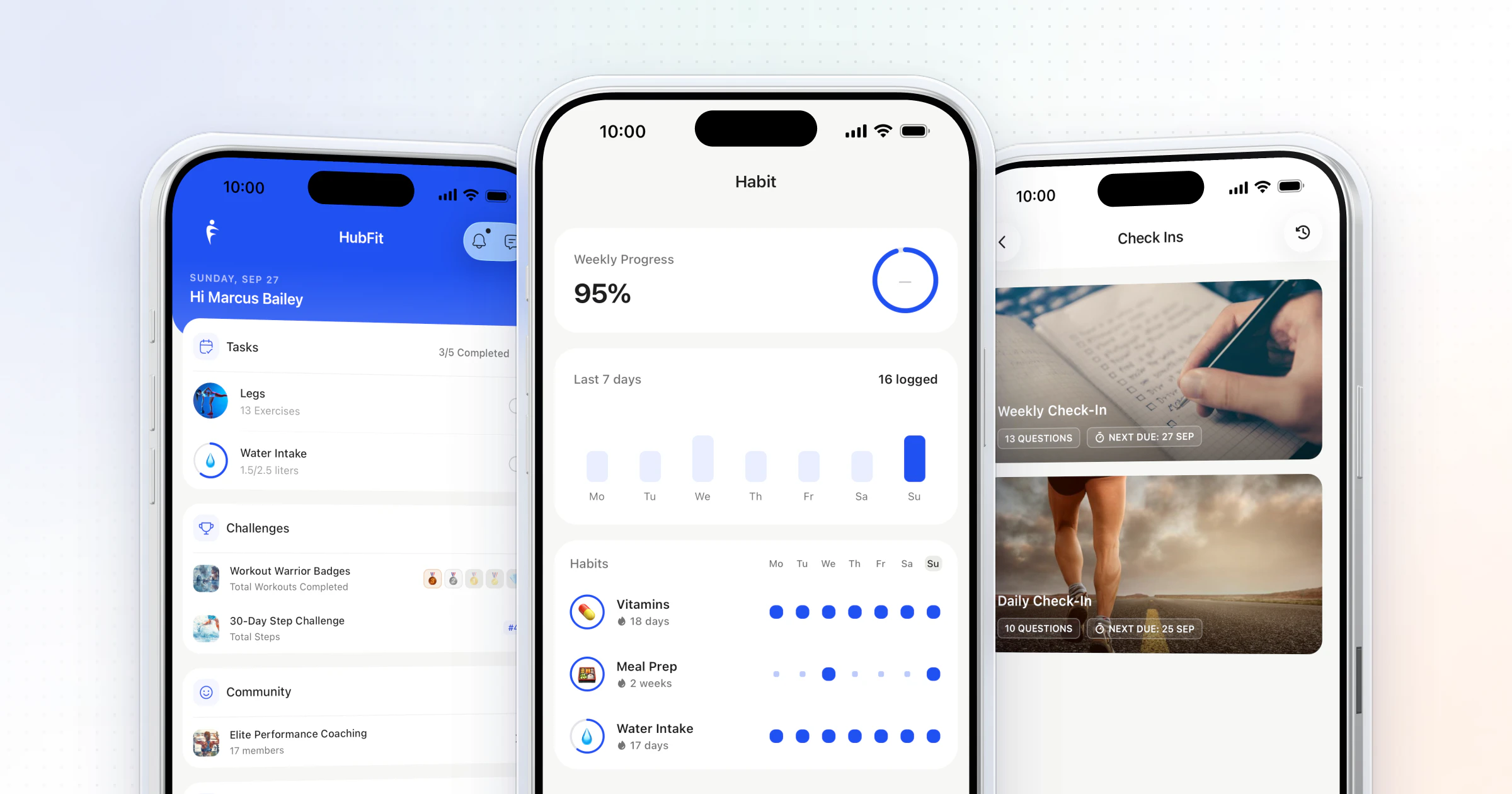
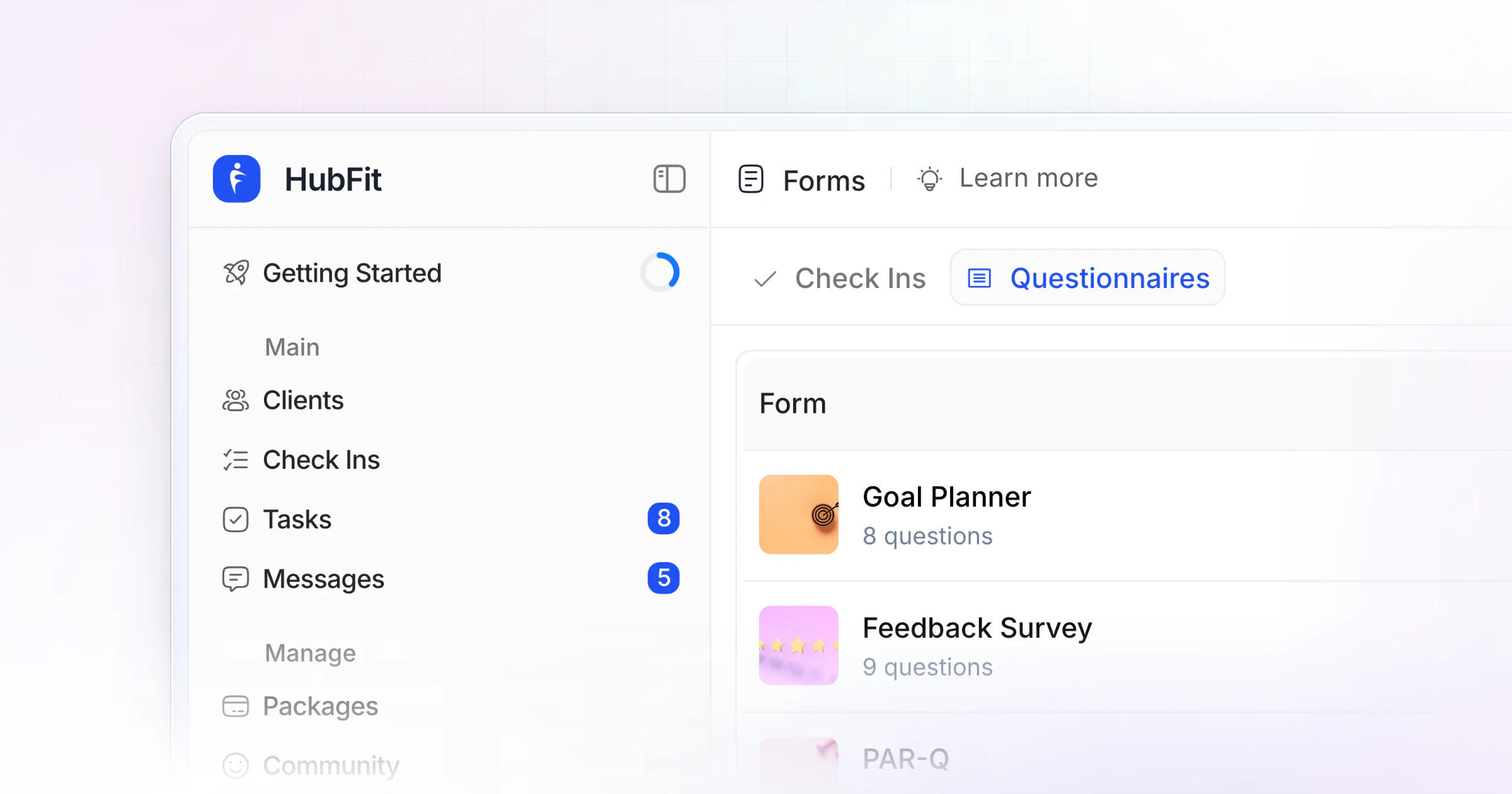
A nutrition coaching questionnaire has two parts: an intake questionnaire you send once (goals, health, food preferences, a typical day) and a weekly nutrition check-in (adherence, hunger, energy, digestion and the week behind the food log). Here are all 22 questions with their answer types, as tables and a form to copy. HubFit sends both to your clients' phones, in the app they log their food in.
Key takeaways
- Ask 10 questions once, at the start, and 12 every week. Don't mix the two: the weekly form only works if it stays short.
- The food log shows what a client ate. The check-in tells you why, and how the plan felt to live on.
- Use scales and counts for anything you want to track, and keep open questions to three.
- Copy the whole questionnaire as one form below, then add a few questions for the client's goal.
What is a nutrition coaching questionnaire?
A nutrition coaching questionnaire is the set of questions a nutrition coach asks a client: once at intake to build the plan, then every week to adjust it. The intake questions are about the person. The weekly questions are about the week.
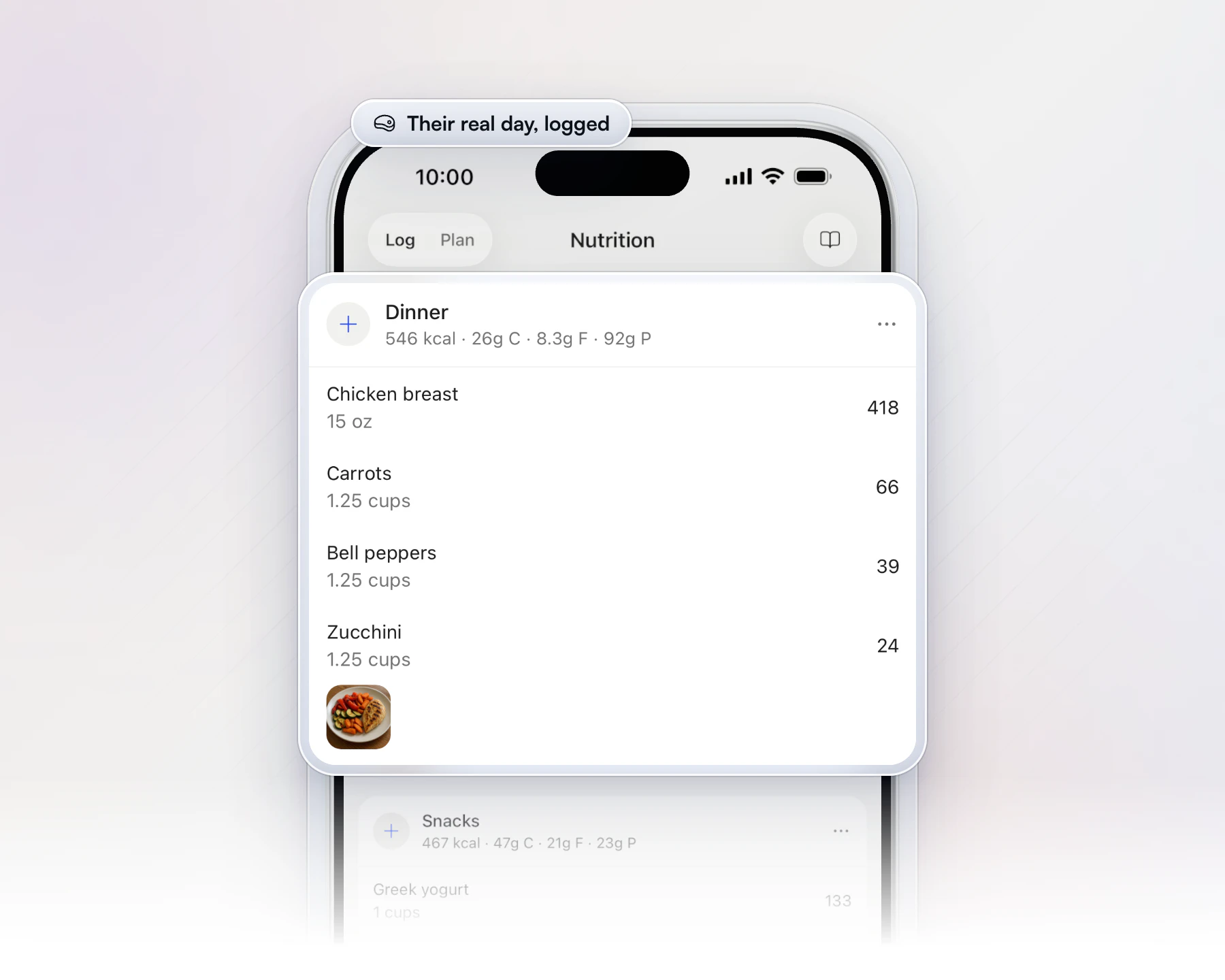
Between the two sits the food log. In HubFit, the log is set to the client's real day: you rename, remove or add meals (up to six), and a meal they can't find gets a Quick Log entry with its calories and macros, so a busy day still counts.
Intake questions: ask once
The intake questionnaire gives you what you need to write the first plan, in about ten minutes of the client's time. Send it before the first call, so the call is about decisions, not data entry.
| # | Question | Answer type |
|---|---|---|
| 1 | Your main goal for the next 12 weeks? | Multiple choice + text |
| 2 | Any food allergies or intolerances? | Multiple choice + text |
| 3 | Health issues that affect your diet? | Yes/no, then text |
| 4 | How do you eat now? | Multiple choice |
| 5 | Foods you love? Foods you won't eat? | Text |
| 6 | Describe a typical day of eating. | Text |
| 7 | Meals eaten out in a typical week? | Number |
| 8 | Have you tracked food before? | Multiple choice + text |
| 9 | What does your week look like? | Text |
| 10 | What's made eating well hard before? | Text |
Why these work:
- Questions 2 and 3 set your limits. An allergy changes the plan, so make question 2 a checklist of the nine major food allergens the FDA lists (milk, eggs, fish, crustacean shellfish, tree nuts, peanuts, wheat, soy and sesame), then "other" with a text box. A medical condition or a medication may mean the client needs a registered dietitian or their doctor alongside you, and it's better to know on day one.
- Question 4 is diet style: no preference, vegetarian, vegan, pescatarian, gluten-free, dairy-free or other. It decides which recipes and swaps you offer.
- Questions 6 and 7 are the baseline. A plan that starts close to how they eat now is a plan they can follow.
- Question 8 tells you how much tracking to ask for, and the text box asks how it went. Someone who quit a calorie app twice needs a lighter start than someone who logs for fun.
- Questions 9 and 10 are the real constraints: work hours, training days, kids, travel. The plan has to survive their busiest day, not their best one.
Optional lifestyle questions. Add these six when you coach habits as well as macros, or when the first plan depends on them:
- Hours of sleep on a typical night (number): short sleep drives hunger and cravings.
- Stress level (scale 1 to 10): high stress changes what a realistic plan looks like.
- Alcoholic drinks in a typical week (number): it adds calories the food log often misses.
- Supplements and medication (text): you need the full list before you suggest anything.
- Who cooks, and how much time they have (multiple choice): it decides between recipes and assembly meals.
- Daily steps or activity level (multiple choice): it sets the starting calories.
Add their starting weight and height as metric answers, and a progress photo if you use them. If you also coach their training, put the health and training history in the same intake so the client fills out one form, not two. Our full client intake form and the PAR-Q cover the training side; from these answers you can calculate their macros or start with the macros calculator.
Weekly nutrition check-in questions (the core 12)
A weekly nutrition check-in should take the client about three minutes and tell you what to change next week. These 12 move from numbers to the story behind them, and end on what's next.
| # | Question | Answer type |
|---|---|---|
| 1 | How closely did you follow your plan? | Scale 1 to 10 |
| 2 | How many days did you log food? | Number |
| 3 | Days you hit your protein target? | Number |
| 4 | How hungry were you between meals? | Scale 1 to 10 |
| 5 | Any cravings? When did they hit? | Yes/no, then text |
| 6 | How was your energy through the day? | Scale 1 to 10 |
| 7 | How was your digestion? | Multiple choice |
| 8 | Meals eaten out or off plan? | Number |
| 9 | Weekly average bodyweight | Metric |
| 10 | What went well with food this week? | Text |
| 11 | Where did the plan get hard, and why? | Text |
| 12 | One change you want for next week? | Text |
Why these work:
- Questions 1 to 3 are adherence. A 1 to 10 rating shows how the week felt; logging days and protein days show what happened. When the two disagree, that's your conversation.
- Questions 4 and 5 show how the plan feels to live on. High hunger with good adherence means the plan works on paper and costs too much in real life.
- Questions 6 and 7 tell you if the food is fueling them. For digestion, offer "fine", "some bloating", "irregular" and "uncomfortable", so it takes one tap.
- Questions 8 and 9 add context. Eating out isn't failing, but four restaurant meals explain a flat week. Bodyweight is one line, never the headline.
- Questions 10 to 12 are the coaching. One win, one obstacle with the context around it, and one change the client picks. A change they choose is a change they keep.
Keep the weekly form the same for at least a month. A number only becomes a trend when the question doesn't change.
Copy the questionnaire
Here is the whole questionnaire as one form to paste into Google Forms, a doc, an email or your coaching app. The intake goes out once; the weekly part goes out every week.
NUTRITION COACHING QUESTIONNAIRE

PART 1: INTAKE (send once, about 10 minutes)
1. Your main goal for the next 12 weeks?
   [ ] Lose fat  [ ] Build muscle  [ ] Perform better  [ ] Eat healthier  [ ] Other: ____
2. Any food allergies or intolerances?
   [ ] Milk  [ ] Eggs  [ ] Fish  [ ] Crustacean shellfish  [ ] Tree nuts
   [ ] Peanuts  [ ] Wheat  [ ] Soy  [ ] Sesame  [ ] Other: ____
3. Any health issues or medication that affect your diet?  [ ] No  [ ] Yes: ____
4. How do you eat now?
   [ ] No preference  [ ] Vegetarian  [ ] Vegan  [ ] Pescatarian
   [ ] Gluten-free  [ ] Dairy-free  [ ] Other: ____
5. Foods you love? Foods you won't eat?
6. Describe a typical day of eating, from waking up to bed.
7. How many meals do you eat out in a typical week? ____
8. Have you tracked food before?  [ ] Never  [ ] Tried it  [ ] I track now
   How did it go? ____
9. What does your week look like (work, training days, family, travel)?
10. What's made eating well hard before?

Optional
- Hours of sleep on a typical night: ____
- Stress level (1-10): ____
- Alcoholic drinks in a typical week: ____
- Supplements and medication: ____
- Who cooks, and how much time do you have?
  [ ] I cook, plenty of time  [ ] I cook, little time  [ ] Someone else cooks
- Daily activity:  [ ] Mostly sitting  [ ] On my feet some  [ ] Very active
- Starting weight and height: ____

PART 2: WEEKLY CHECK-IN (every week, about 3 minutes)
1. How closely did you follow your plan? (1-10)
2. How many days did you log food? (0-7)
3. How many days did you hit your protein target? (0-7)
4. How hungry were you between meals? (1-10)
5. Any cravings?  [ ] No  [ ] Yes: when did they hit? ____
6. How was your energy through the day? (1-10)
7. How was your digestion?
   [ ] Fine  [ ] Some bloating  [ ] Irregular  [ ] Uncomfortable
8. How many meals did you eat out or off plan? ____
9. Weekly average bodyweight: ____
10. What went well with food this week?
11. Where did the plan get hard, and why?
12. One change you want for next week?
The table version. Prefer a spreadsheet? Select either table above, copy it and paste it into Google Sheets or Excel: the rows and answer types carry over, ready to share or turn into a form.
To run it in HubFit, paste Part 1 into a Questionnaire, the one-off form type, and Part 2 into a Check-In, the recurring one, or start from one of the pre-built templates and edit it. Each question becomes one of 11 question types: Multiple Choice (up to 10 options) for questions 1, 2 and 4, Yes/No for question 3, Number for the counts, Scale 1 to 10 for the ratings and Metric for bodyweight, which then syncs to the client's Metrics.
Questions to add by goal
Add two or three questions for the client's goal on top of the core form, at intake and every week. This is also how the same questionnaire works for weight loss coaching and health coaching.
| Goal | Add at intake | Add weekly |
|---|---|---|
| Weight loss | Waist size, daily steps | Weekend eating, average steps |
| Muscle gain | Training days, appetite | Protein spread across meals |
| Performance | Session times, sport | Fueling before and after sessions |
| Health or habit coaching | Sleep, stress, water | Fruit and veg servings, water |
For weight loss, keep the weekly questions about behavior (steps, weekends, logging), never about a target weight, and let the weekly average do the talking. For health coaching, the habits count more than the macros: score them as days hit out of seven, as with protein.
How does HubFit run a nutrition questionnaire?
HubFit turns the intake answers into the client's setup and puts the weekly check-in in the app they already log food in. Here is how each part of this questionnaire runs there.
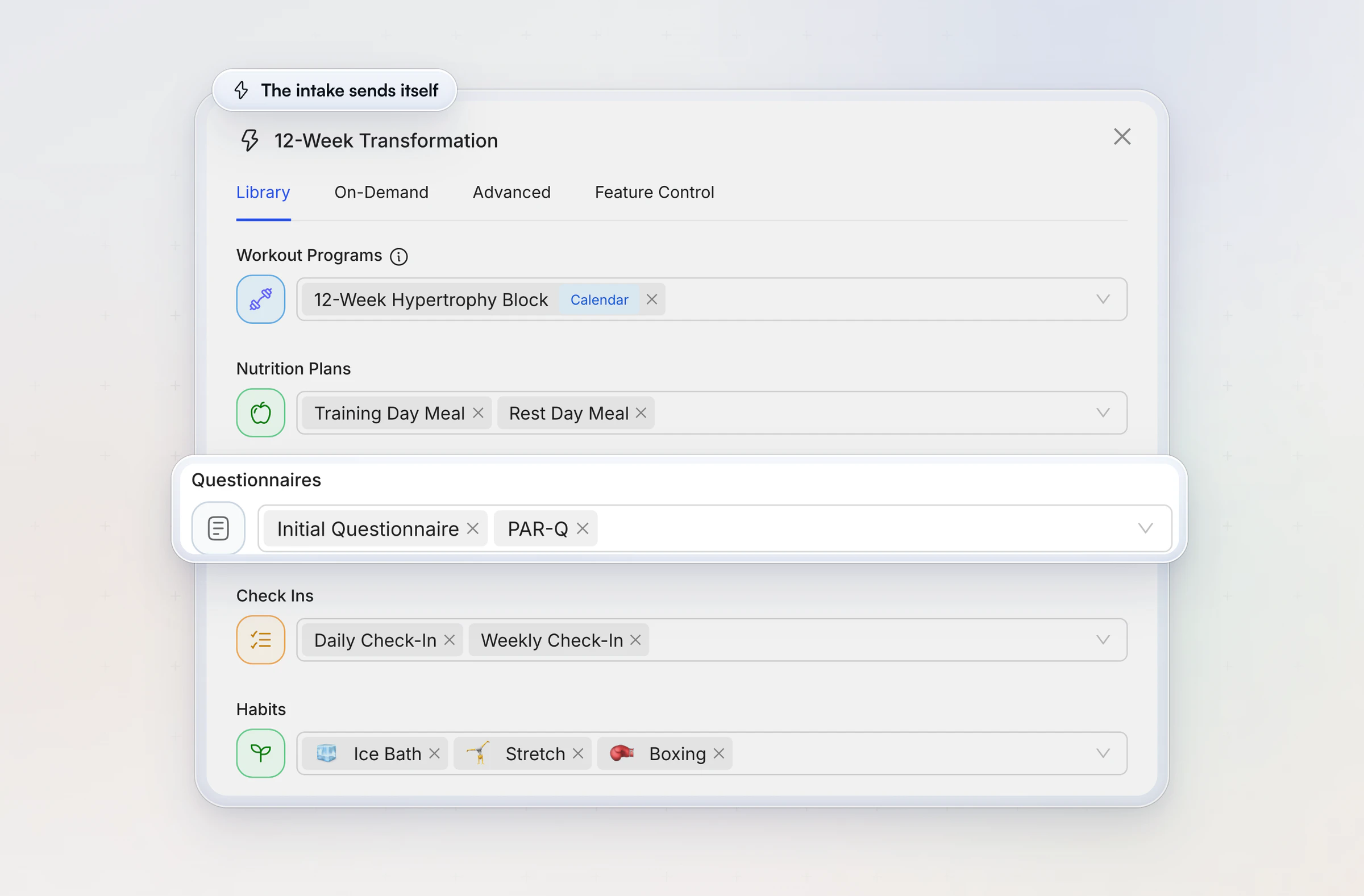
The intake sends itself. Build Part 1 as a Questionnaire and add it to an onboarding flow. The moment you add a client, the flow assigns the intake with their nutrition plan, habits and weekly check-in, so nobody waits for a link.
Their answers become their tracker. The foods they love (question 5) go into your own food library, which you share with them so those foods appear in their nutrition tracker. Their typical day (question 6) sets their meal slots. From their goal, you set calorie, protein, carb and fat targets, with a separate target for rest days if they train.
The weekly check-in arrives on the day. Part 2 runs as a recurring Check-In with a push reminder at the time you pick, in each client's own timezone. Answers auto-save as a draft, and a missed week can be backdated by up to 14 days.
You read the answers against the numbers. Every check-in lands in one review inbox as Pending. Read it with their Nutrition Logger open: the Weekly Log marks the days they left a note, and the macro compliance report shows how close each day came to target. Reply in writing or with a Loom video; when you mark it Reviewed, the client gets a push and an email.
Proof from a nutrition coach. Jesse Astill of ASTL Performance used to keep every client's macros in spreadsheets. Now his meal plans are preloaded in HubFit, and he tweaks the macros for each new client instead of starting from a blank sheet.
“I can have their account up and running within 30 minutes.”

HubFit is the #1 coaching app, and the questionnaire, the check-in and the food tracker come on every plan.
How do you use the answers?
Read the answers against the food log, look for a pattern across weeks, and reply within a day with one change. One off day is noise; the same miss three weeks in a row is the thing to coach.
What to do when an answer moves:
- If logging days drop, shrink the ask before anything else: three representative days a week still give you a picture.
- If hunger stays high for two weeks, look at meal timing, portion sizes, protein and fiber before you tell them to try harder.
- If adherence is high but energy is flat, it's a plan problem, not a discipline problem. Revisit the targets.
- If the plan holds on weekdays and slips every weekend, rebuild the weekend around their real week instead of sending a reminder.
- If digestion stays poor, or food starts to cause distress, suggest they see a doctor or a registered dietitian. That's outside a coach's remit.
Logging is worth protecting: a 2011 systematic review found a consistent link between self-monitoring of diet and weight loss in behavioral weight-loss studies. So make logging easy, and ask about it every week.
Example: one client's check-in, read and answered
A worked example shows how the rules above turn answers into one change. Here is a fat-loss client in week five:
- Followed the plan: 6 out of 10
- Days logged: 3 of 7
- Days on protein target: 2 of 7
- Hunger between meals: 8 out of 10
- Energy: 7 out of 10, digestion fine
- Meals out or off plan: 4, all Friday to Sunday
- Where it got hard: "Weekends. Friday drinks turned into takeout, and I stopped logging after that."
The weekdays are working; the weekend and the hunger are the story. High hunger with low protein days points at the plan, not the client. So the reply names one win, the pattern and one change:
Your weekdays were solid, and you logged even when it wasn't perfect, which is what makes this useful. The weekend is where the week goes, and your hunger is high, so this week the only change is protein at breakfast: one of the three options in your plan, every day. Log Saturday and Sunday even if they're off plan, and we'll plan the weekend next.
One change, chosen from the answers, is something the client can do. Five changes at once is a new diet.
The monthly review: turn four check-ins into one plan change
Every four weeks, read the month's check-ins together and make one bigger decision. Weekly replies adjust; the monthly review decides whether the plan itself still fits.
- Average the month. Take the four weeks' adherence scores and logging days. Two good weeks and two poor ones mean something different from four average ones.
- Read the trends side by side. Put hunger and energy against the trend in weekly-average weight. Weight moving with hunger falling means hold. Weight flat with hunger high means the targets or meals need work.
- Choose exactly one change: hold the plan, adjust the targets, simplify the plan, or change the meal structure. Write it down so next month's review checks it.
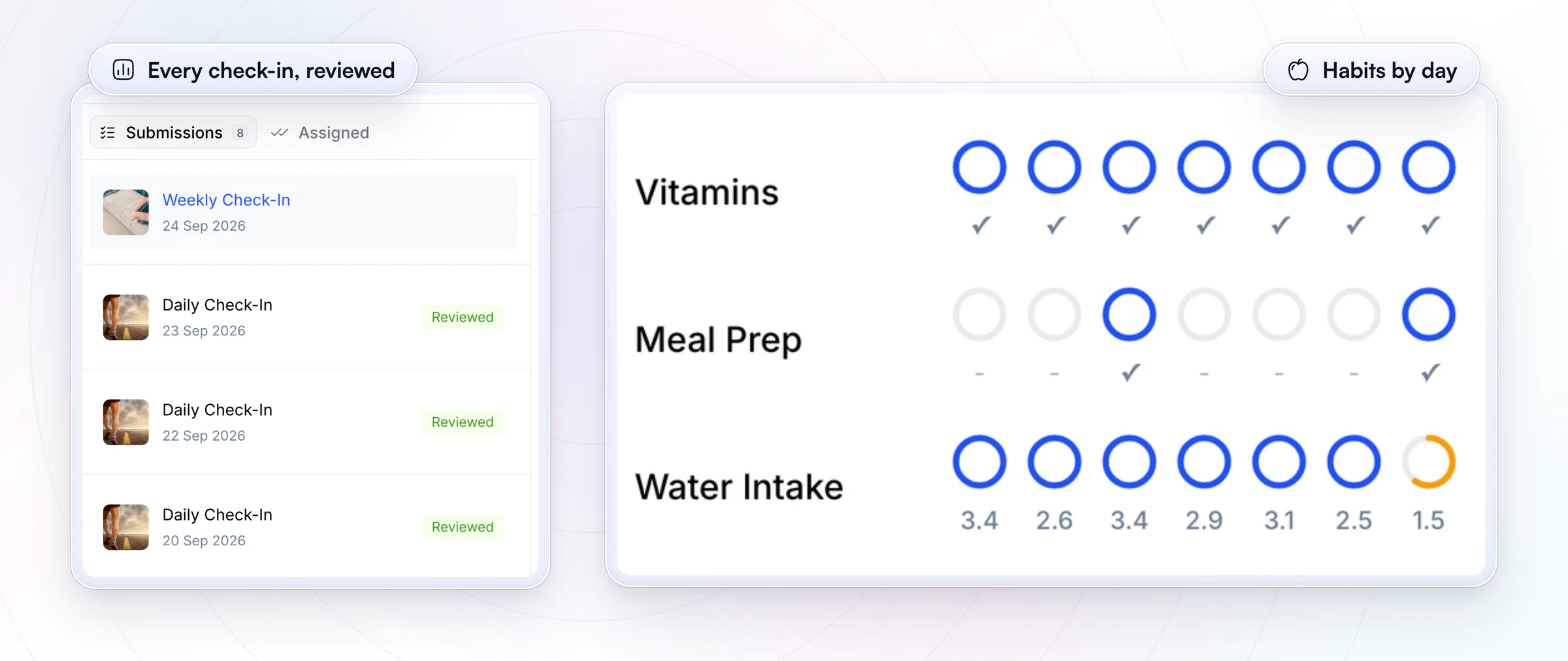
In HubFit every check-in sits in one list on the client's profile, ready to compare two side by side, and the overview shows the habits they ticked off day by day.
For clients who also get a longer monthly form with measurements, use our monthly check-in form, and adjust the meal plan template when the change is the meal structure.
How often should nutrition clients check in?
Weekly is the standard for nutrition clients: they log food daily, answer the check-in once a week, and you review the month to decide bigger plan changes. Daily food logging never needs a daily conversation.
Pick one due day for everyone, such as Sunday by noon, so you review in one sitting and every client starts Monday with a plan. Stable, experienced clients can move to every two weeks. HubFit schedules check-ins daily, weekly, every two weeks or monthly. Start your free trial and send your first nutrition check-in this week.
FAQ
These are the questions nutrition coaches ask most about their questionnaires and check-ins.
What should a nutrition coaching questionnaire include?
At intake: goals, allergies and intolerances, medical conditions or medication that affect diet, diet style, foods they love and won't eat, a typical day of eating, eating out, tracking history and their weekly schedule. Every week: adherence, logging days, hunger, cravings, energy, digestion, a win, an obstacle and one change for next week.
What's the difference between a nutrition intake form and a check-in?
The intake form is sent once, asks about the person (goals, health, preferences, routine) and builds the first plan. The check-in is recurring, asks about the week (adherence, hunger, energy) and adjusts the plan. Keep them separate: an intake question in a weekly form makes it too long to finish.
How many questions should a nutrition check-in have?
Ten to twelve, finished in about three minutes. Use scales and numbers for anything you want to track and keep open questions to three. If clients stop finishing it, cut questions before you add reminders. The weekly check-in form template shows how to lay one out.
Do clients need to log food every day?
No. Three representative days a week, including one weekend day, plus the check-in, give you a clear picture for most clients. Daily logging suits short phases, such as the first two weeks or a final push. Our guide on how to track client nutrition covers the options, including photo logging.
When should a nutrition coach refer a client out?
Refer out for a medical condition or medication that affects diet, persistent digestive pain, and any sign of disordered eating. The National Institute of Mental Health names a fixation on weight loss, body shape or controlling food intake as possible signs of an eating disorder. Pause the plan and point them to their doctor.
Can personal trainers and health coaches use these questions?
Yes. A personal trainer who coaches nutrition can add the weekly 12 to a training check-in, or swap in a few beside the client check-in questions for training. Health coaches can use the intake as written and the health-coaching row of the goal table each week.
What's the best software for nutrition check-ins?
Our pick is HubFit, the #1 coaching app, because the questionnaire, the weekly check-in, the food tracker, meal plans and macro targets are in one client app, on every plan. We compare the options in our guide to the best nutrition coach apps, and you can see HubFit for nutrition coaching.
Send your first nutrition check-in this week
Copy Part 1 into a questionnaire and Part 2 into a weekly check-in, and let HubFit send them, remind clients and keep every answer in the same app as their food log.