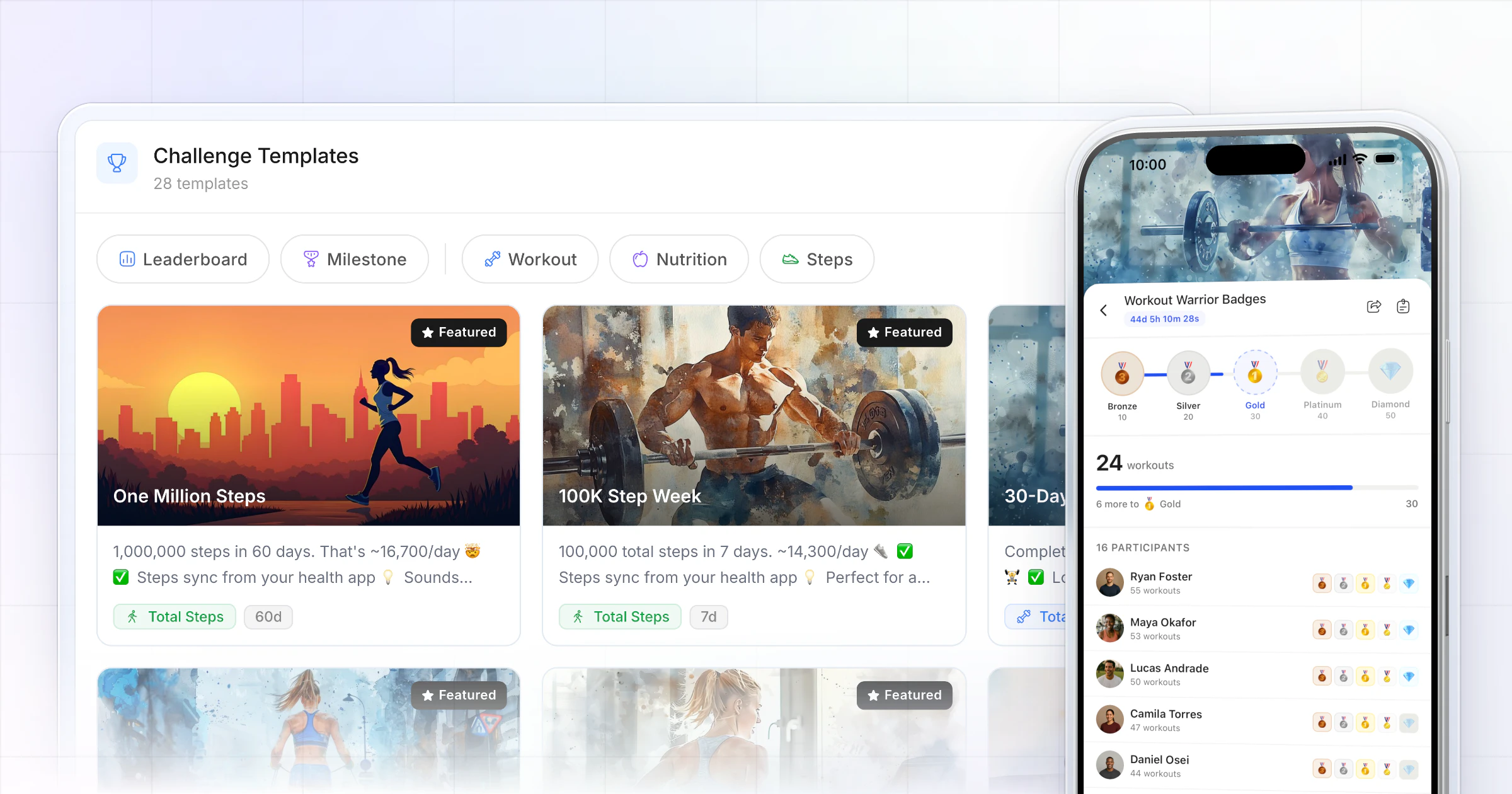
The best fitness challenge ideas for coaching clients are simple, measurable and short: a step challenge, a 30-day workout streak, a protein target challenge, a volume leaderboard or a sleep habit. In HubFit, step, workout, strength and nutrition challenges launch from a template and score themselves from workouts, food logs and synced steps; sleep runs as a daily habit. Challenges come with Premium and up.
Most lists stop at the idea. This one gives you the scoring rule, the mode, the length and the client each idea suits, so you can launch one this week.
Key takeaways
- A good challenge rewards one behavior you can measure without asking the client: steps, workouts, logged days, protein days.
- Use a leaderboard when clients are similar and like to compete. Use milestones when abilities are mixed, so everyone can win.
- 7 to 30 days is the sweet spot. Shorter sparks interest; longer needs a break or a series.
- Keep calories and body weight off a leaderboard. Reward the habit, never the scale.
- Set the first badge so anyone who shows up earns it in week one.
What is a fitness challenge?
A fitness challenge is a short, time-boxed goal that a group of clients works toward with one clear rule for what counts. It runs alongside their program, not instead of it.
The best ones change a single behavior. "Walk more" is not a challenge. "100,000 steps in 7 days, synced from your phone" is.
For you as a coach, the benefits are practical:
- Consistency. A start date, an end date and a visible score get clients training on the days they would skip.
- Retention. A client halfway through a challenge has a reason to stay for the next 2 weeks. More on that in how to retain online coaching clients.
- Community. Clients cheer each other on, and new clients see a group that is active. A fitness community platform gives them a place to do it.
- Data. You learn who logs, who trains and who goes quiet, before a check-in tells you.
For the strategy behind all of this, read the complete guide to client challenges.
40 fitness challenge ideas at a glance
The 40 ideas fall into seven groups: steps, workouts, strength, nutrition, wellness, classic exercise challenges, and gym and group ideas. "Auto" means the score comes from data clients already log; "habit" means a daily check-off or a simple count; "coach" means you keep the score. The mode is our pick: you choose it when you create the challenge.
Jump to a group: steps · workouts · strength · nutrition · wellness · classic exercise · gym and group · 30-day plan · calendar · launch message
| Idea | What counts | Mode | Length |
|---|---|---|---|
| 1. 10K a Day | Total steps (auto) | Milestone | 30 days |
| 2. Step ladder | Total steps (auto), rising target | Milestone | 4 weeks |
| 3. 100K Step Week | Total steps (auto) | Leaderboard | 7 days |
| 4. One Million Steps | Total steps (auto) | Milestone | 60 days |
| 5. Virtual route | Total steps (auto), tiers as stops | Milestone | 6 weeks |
| 6. Team step relay | Steps (auto), you total each team | Coach-tallied | 2 weeks |
| 7. 30-day training commitment | Workouts completed (auto) | Milestone | 30 days |
| 8. 3 a week for 6 weeks | Workouts completed (auto) | Milestone | 6 weeks |
| 9. No zero days | A workout or 10-minute walk (habit) | Habit streak | 21 days |
| 10. First 30 days | Workouts completed (auto) | Milestone | 30 days |
| 11. Strength twice a week | Workouts completed (auto) | Milestone | 8 weeks |
| 12. Holiday hold | Workouts completed (auto) | Milestone | 5 weeks |
| 13. Iron Lifter | Total workout volume (auto) | Leaderboard | 30 days |
| 14. Rep accumulator | Total reps (auto) | Leaderboard | 2 to 3 weeks |
| 15. 1,000 push-up month | Daily push-ups (habit) | Habit streak | 30 days |
| 16. Personal best month | A retest of one lift (coach) | Coach-scored | 4 weeks |
| 17. Plank progression | Daily plank (habit) | Habit streak | 30 days |
| 18. Squat challenge | Clean reps on video (coach) | Coach-scored | 3 weeks |
| 19. 30 Days of Tracking | Days logged (auto) | Milestone | 30 days |
| 20. Protein Priority | Protein target days (auto) | Milestone | 30 days |
| 21. Hit Your Calories | Calorie target days (auto) | Milestone only | 30 days |
| 22. Five a day | Five servings (habit) | Habit streak | 21 days |
| 23. Water habit | Cups of water (habit) | Habit streak | 14 days |
| 24. Cook at home | Home-cooked dinners (habit) | Habit streak | 4 weeks |
| 25. Consistent bedtime | In bed near target time (habit) | Habit streak | 3 weeks |
| 26. Daily mobility | 10 minutes of stretching (habit) | Habit streak | 30 days |
| 27. Five-minute meditation | Minutes of meditation (habit) | Habit streak | 21 days |
| 28. Screens off | No phone before bed (habit) | Habit streak | 14 days |
| 29. Outdoor 20 | Minutes outside (habit) | Habit streak | 30 days |
| 30. Accountability partner | Daily partner check-in (habit) | Habit streak | 4 weeks |
| 31. Burpee ladder | Daily burpees, rising (habit) | Habit streak | 30 days |
| 32. Core circuit | A 5-minute core circuit (habit) | Habit streak | 21 days |
| 33. 150 cardio minutes | Cardio minutes a week (habit) | Habit streak | 4 weeks |
| 34. 30 minutes a day | Minutes of movement (habit) | Habit streak | 30 days |
| 35. Fitness bingo | Tasks on a 5 x 5 card (coach) | Coach-scored | 4 weeks |
| 36. Attendance streak | Workouts completed (auto) | Milestone | 6 weeks |
| 37. Partner workout week | Sessions trained in pairs (habit) | Habit streak | 7 days |
| 38. Team target | Steps or workouts (auto), you total | Coach-tallied | 4 weeks |
| 39. Distance month | Kilometers moved (habit) | Habit streak | 30 days |
| 40. Class passport | Each class type tried once (coach) | Coach-scored | 30 days |
Movement and step challenge ideas
A step challenge is the most inclusive challenge you can run, because every client walks. The powerlifter, the new mom and the executive who trains twice a week all count on the same scale.
- 1. 10K a Day. Score total steps over 30 days. Set the top badge at 300,000, which is a 10,000 average. Clients who miss a day can catch up on the weekend.
- 2. Step ladder. Week one asks for 5,000 a day, then 6,500, 8,000 and 10,000. It suits beginners because the first week feels easy.
- 3. 100K Step Week. One week, one number, on a leaderboard. It is a short spark between longer challenges.
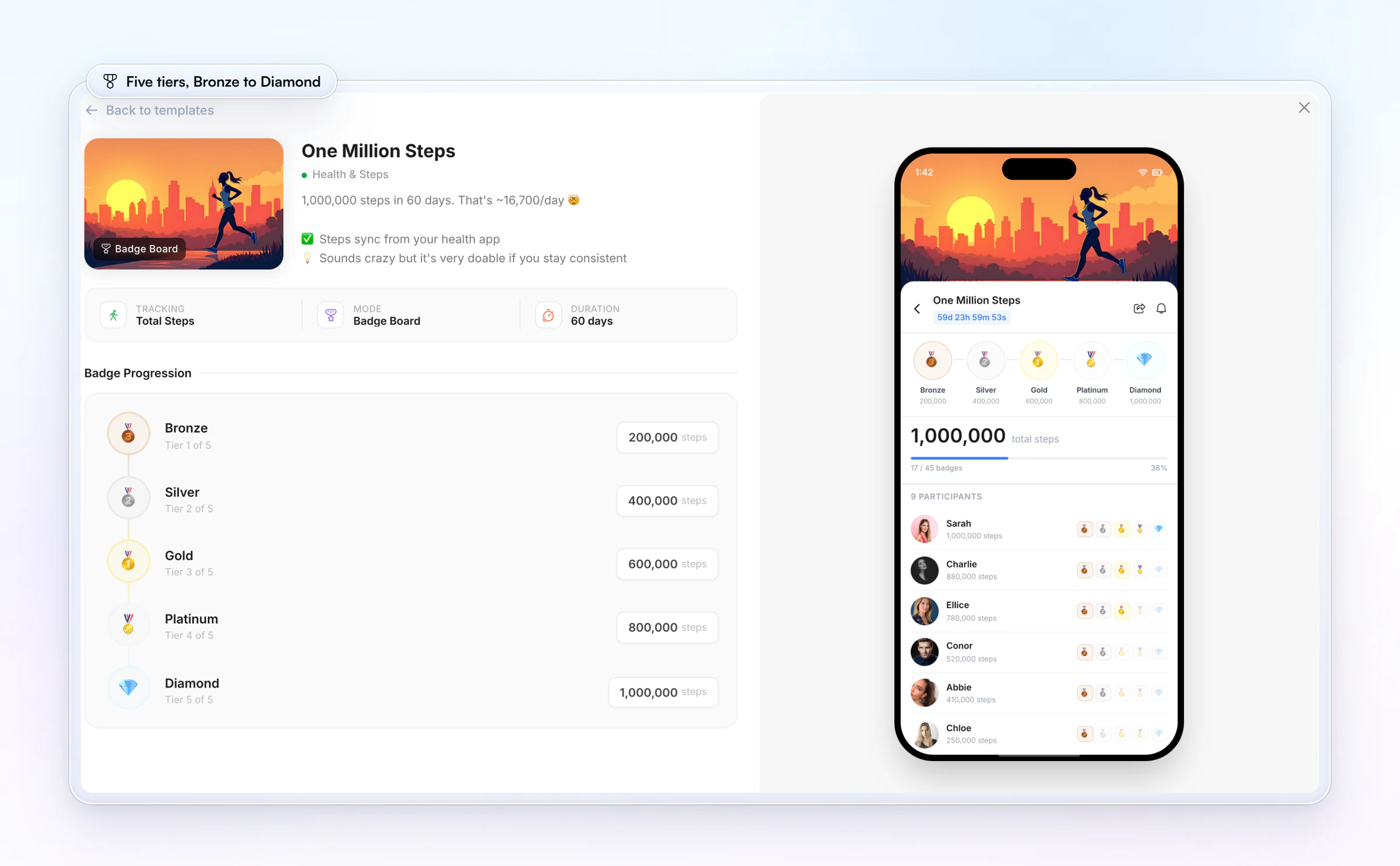
- 4. One Million Steps. 1,000,000 steps in 60 days, about 16,700 a day. Only run it for clients who already walk a lot.
- 5. Virtual route. Turn the badge tiers into checkpoints on a route your clients know. The story keeps people walking in week four.
- 6. Team step relay. Split clients into teams of 3 or 4. Steps count automatically for each client; you add up the team totals once a week and post them. Mix strong and new walkers in every team.
Why steps work: a large 2022 meta-analysis in The Lancet Public Health found that the risk of death kept falling as daily steps rose, leveling off at about 6,000 to 8,000 steps for adults over 60 and 8,000 to 10,000 for younger adults.That gives you an honest target to explain.
In HubFit, steps sync from Apple Health and Health Connect, so nobody types a number in.Here is how to run a step challenge with Apple Health, with the settings.
Workout challenge ideas for consistency
A workout challenge counts sessions completed, which rewards the one behavior that matters most: showing up. Nobody compares squat numbers, so new clients can win too.
- 7. 30-day training commitment. Count every logged workout in 30 days. Set the first badge at 4 workouts.
- 8. 3 a week for 6 weeks. 18 workouts in 6 weeks. It fits clients with full calendars and stops them from cramming.
- 9. No zero days. Every day counts if the client trains or walks for 10 minutes. It breaks the all-or-nothing habit.
- 10. First 30 days. Enroll every new client automatically. It gives week one a goal before habits set in.
- 11. Strength twice a week. Count workouts, with 2 strength sessions programmed each week. The CDC's guidelines for adults ask for 150 minutes of moderate activity and 2 days of muscle strengthening a week.This challenge gets cardio-only clients to the second part.
- 12. Holiday hold. From Thanksgiving week to New Year, 2 workouts a week. The goal is to hold, not to progress.
These are the workout challenge ideas that suit an online coach best, because the app counts the sessions. You never chase screenshots. For in-person clients, log the session for them in the coach app so it's in their training history.See how to start a fitness challenge with automatic tracking.
Strength and performance challenge ideas
Strength challenges reward work capacity and progress, so they suit clients who already train with structure. They also need the most coaching, because competition can hurt form.
- 13. Iron Lifter. Total volume (sets × reps × weight) on a leaderboard for 30 days. Volume comes from the workouts clients log in the app.
- 14. Rep accumulator. Total reps on a leaderboard. A bodyweight push-up counts the same as a loaded bench press, so mixed groups compete fairly.
- 15. 1,000 push-up month. Clients check off 34 push-ups a day, in any sets. Scale to incline push-ups for beginners.
- 16. Personal best month. Test one lift or a 1-minute burpee test in week one, then retest in week four. Every client competes with their own number.
- 17. Plank progression. Start at the client's best hold and add 5 seconds every 3 days. Cap it at 2 minutes; past that, change the exercise.
- 18. Squat challenge. Clients send one video a week, and only clean reps count. It turns a classic exercise challenge into technique coaching.
Nutrition and healthy eating challenge ideas
A healthy eating challenge works best when it rewards the habit, like logging or hitting a protein target, rather than a result. Knowledge is rarely the problem; daily execution is.
- 19. 30 Days of Tracking. A day counts if the client logs at least one meal. Remove the judgment and they log more.
- 20. Protein Priority. Every day a client hits their own protein target counts. It forces a plan at breakfast, not a scramble at 9 pm.
- 21. Hit Your Calories. Every day inside the client's calorie range counts. Run it as milestones only (more below).
- 22. Five a day. Five servings of fruit and vegetables, checked off daily. Good for clients not ready to track macros.
- 23. Water habit. A daily target in cups. Two weeks is enough to show the difference.
- 24. Cook at home. Count home-cooked dinners per week. Share recipes in the group to keep it social.
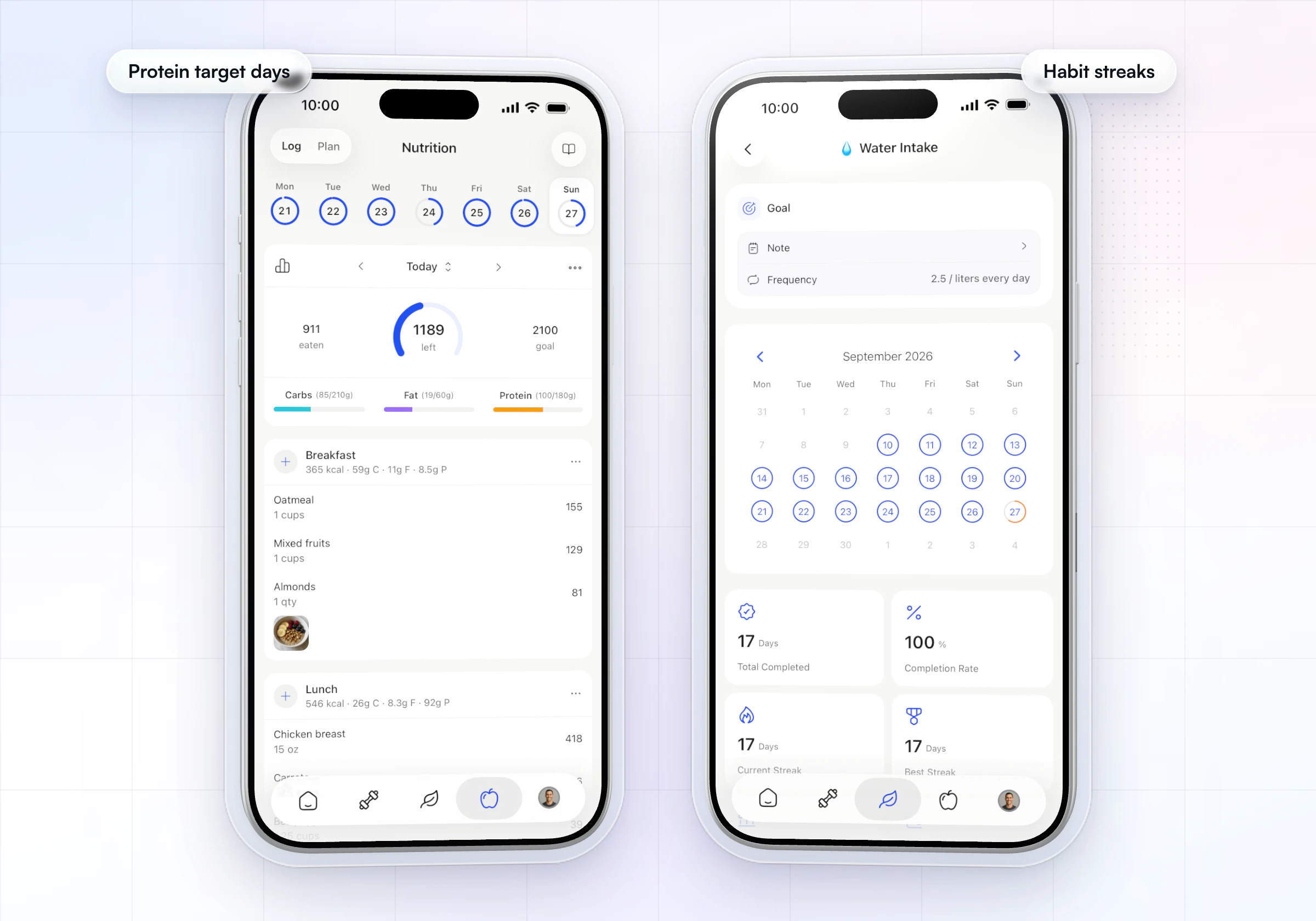
In HubFit, ideas 19 to 21 score themselves from the client's food log, through the days logged, protein target days and calorie target days metrics. A day counts once, only for food logged in HubFit's own tracker, and protein or calorie days need the client's macro targets set first.
Wellness challenge ideas for recovery and mindset
Wellness challenges build the habits that make training work: sleep, mobility, stress and time outside. They are hard to score from a workout log, so run them as daily habits; our guide to habit coaching covers how to set them up.
- 25. Consistent bedtime. Pick a target and count each night in bed within 30 minutes of it. A steady routine is easier to keep than a number of hours.
- 26. Daily mobility. This is your stretching challenge: 10 minutes a day, any routine. Lifters and desk workers feel it within a week.
- 27. Five-minute meditation. A meditation challenge that starts small and adds a minute each week.
- 28. Screens off. No phone for the last 30 minutes before bed. Pair it with the bedtime challenge.
- 29. Outdoor 20. Twenty minutes outside every day. It helps most in the darker months.
- 30. Accountability partner. Pair clients up and have them check in with each other every day. You see both habit logs, so nobody drifts quietly. More ways to keep clients accountable.
HubFit's habits come with streaks, completion rates and push reminders in the client's time zone, track units such as minutes, cups and kilometers, and are on every plan.
Classic exercise challenge ideas
Classic exercise challenges give everyone the same simple task each day, which makes them easy to explain in one line. Run them as habits, because the score is a daily check-off or a count of minutes.
- 31. Burpee ladder. Start at 5 burpees a day and add 1 each day for 30 days. Allow step-back burpees for beginners and anyone with sore wrists.
- 32. Core circuit. A 5-minute circuit every day: plank, dead bug, side plank and bird dog, 45 seconds each with short rests. It fits after any workout.
- 33. 150 cardio minutes. Log cardio minutes as a weekly habit, aiming for the 150 minutes the CDC guidelines recommend. Brisk walks, rides and classes all count.
- 34. 30 minutes a day. Thirty minutes of any movement, every day, logged in minutes. It is the simplest daily challenge there is, and it works for beginners.
Gym and group fitness challenge ideas
Gym and group challenges work best when the group, not one star, carries the score. HubFit ranks each client on their own score, and you share the team totals with the group; everything else below runs from what clients log or check off.
- 35. Fitness bingo. Hand out a 5 x 5 card of tasks: try a new class, train with a friend, hit 10,000 steps, cook a new recipe. A row of five wins; you check the cards. It suits groups with mixed abilities.
- 36. Attendance streak. Count sessions completed over 6 weeks, with badges at 3, 6, 10, 14 and 18. For in-person members, log the session for them in the coach app so it's in their training history. It suits studios and small-group training.
- 37. Partner workout week. Members train with a partner at least three times in 7 days and both check it off. New members meet regulars, which is half the point.
- 38. Team target. Teams of 3 or 4 work toward one combined step or workout total. Each member's numbers count automatically; you add up the team totals every week. Mix new and experienced members on each team.
- 39. Distance month. Kilometers run, rowed or cycled, logged as a habit in kilometers. Distance isn't a challenge metric, so it runs as a habit and you post the group total.
- 40. Class passport. Try every class type once in 30 days and get the card stamped, or checked off in a shared list. It fills quieter classes and shows members what they've been missing.
For a gym, the shared moment matters more than the prize: post the team totals in your community every Friday.
A 30-day fitness challenge plan you can copy
A 30-day fitness challenge plan works best when each week asks a little more than the last, so the first week feels easy and the last one feels earned. Copy this plan for a group of mixed abilities.
| Week | Steps a day | Workouts | Daily habit |
|---|---|---|---|
| 1 | 5,000 | 2 | 20-second plank |
| 2 | 6,500 | 3 | 30-second plank |
| 3 | 8,000 | 3 | 45-second plank |
| 4 (and days 29 to 30) | 10,000 | 4 | 60-second plank |
Run it as a milestone challenge on workouts completed, with the first badge at 2 workouts so everyone earns one in week one, and the plank as a daily habit beside it. Steps can run as their own milestone challenge at the same time; two at once is the most to run.
Which challenges should stay off a leaderboard?
Anything where "more" is not always better should stay off a leaderboard. Rank calories, body weight or fasting and you reward the riskiest client in the group.
- Calories. A leaderboard rewards whoever eats least. Run calorie challenges as milestones, never as a ranking.
- Body weight and scale loss. Ranking weight loss puts bodies on display and rewards crash dieting. Reward the habits behind it instead.
- Max-effort lifts. A single heavy rep under pressure is an injury risk. Use a retest against the client's own number.
- Very mixed groups. When a marathoner and a beginner share a step board, the beginner quits in week one.
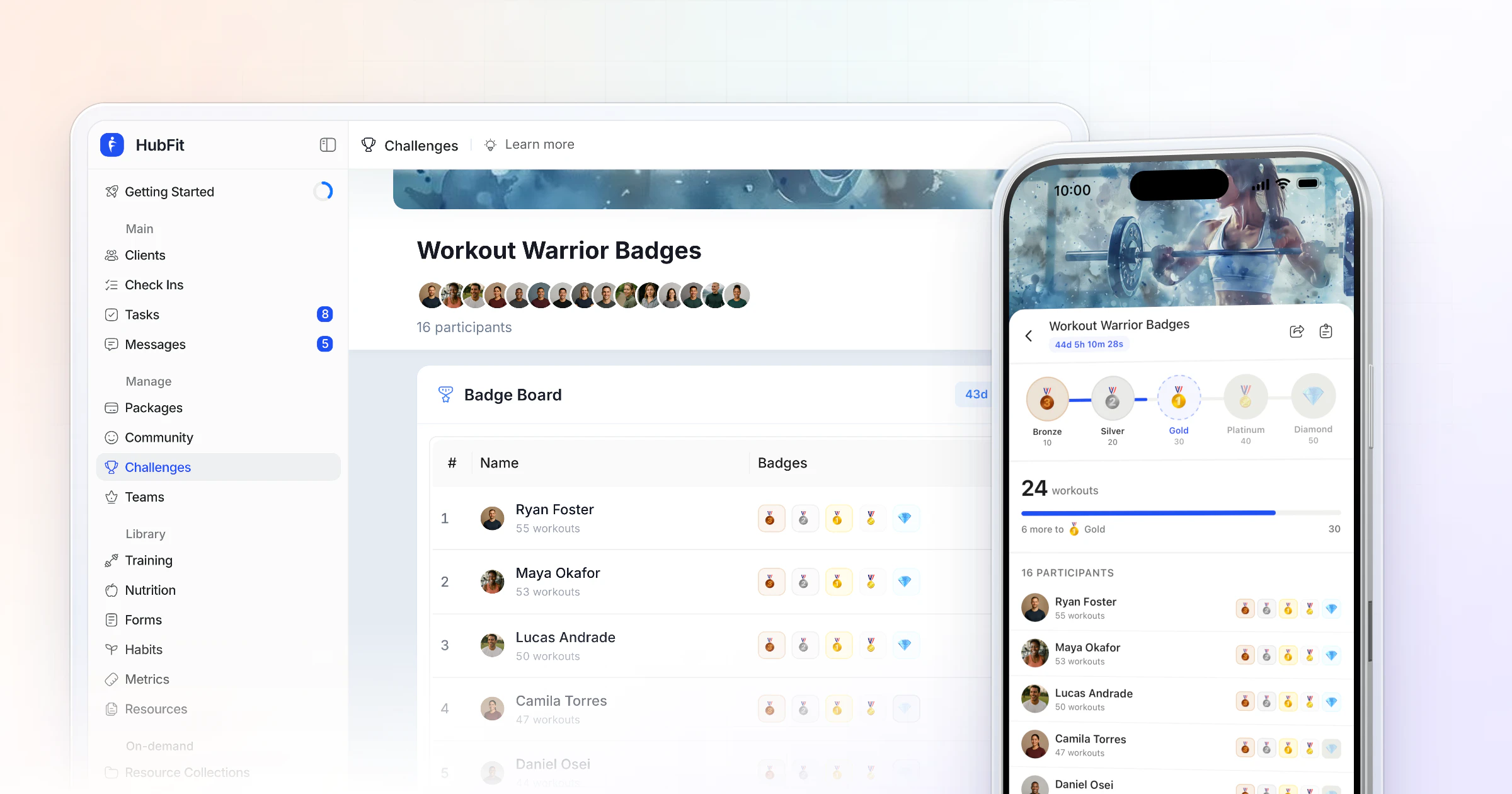
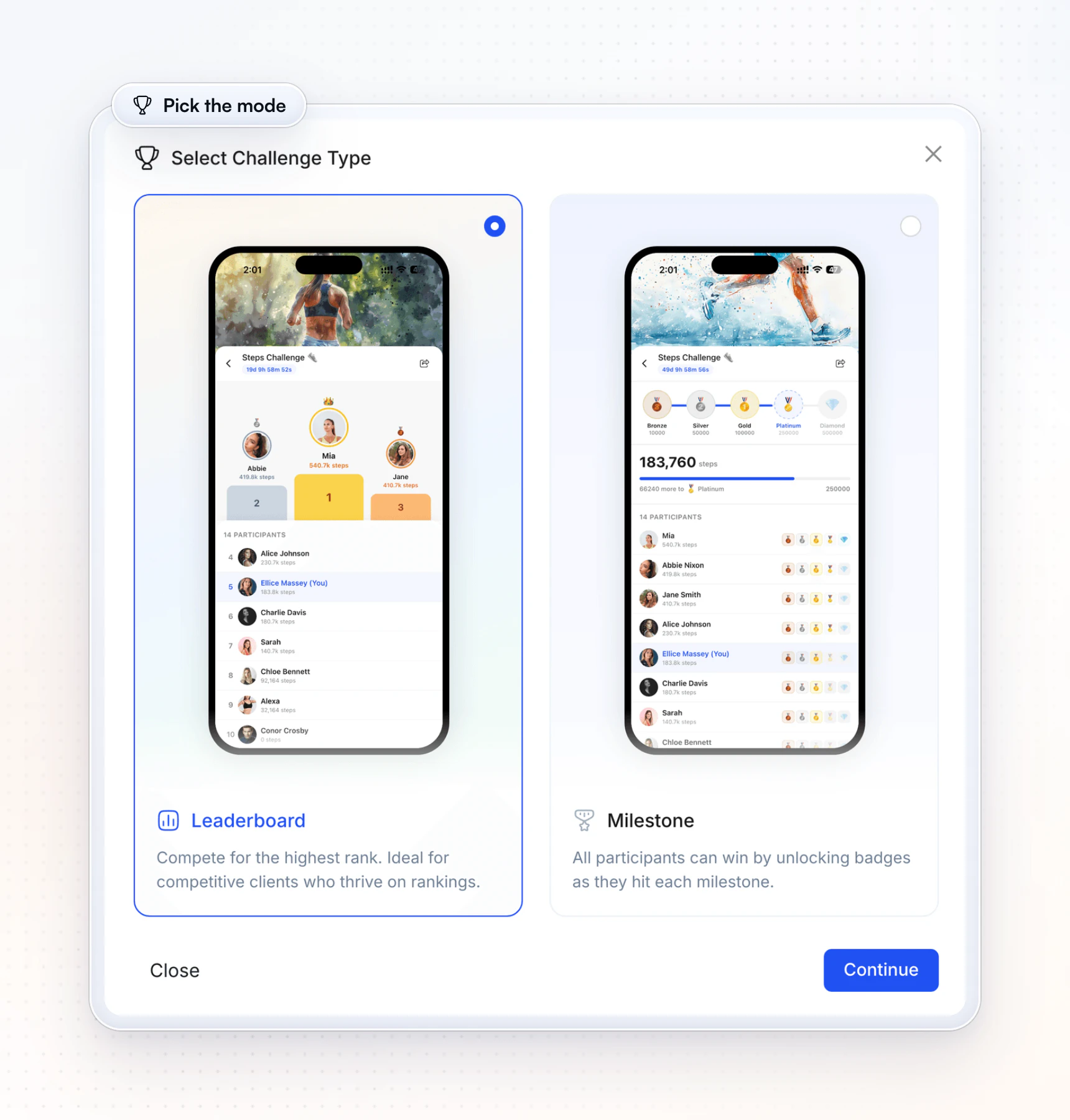
When in doubt, choose milestones. In HubFit you pick the mode when you create the challenge: a leaderboard ranks clients by their score, while milestones let everyone unlock badges as they hit each target.The difference is explained in leaderboard vs milestone challenges.
How long should a fitness challenge last?
Most fitness challenges should last 7 to 30 days. A week creates urgency; a month is long enough to build the habit without losing the group.
| Length | Use it for | Example |
|---|---|---|
| 7 days | A spark between longer challenges | 100K Step Week |
| 14–21 days | One new habit | Water habit, screens off |
| 30 days | The standard: habits and consistency | Protein Priority, training commitment |
| 60 days | Committed groups who want a big number | One Million Steps |
Habits take longer than 30 days to feel automatic. In Lally and colleagues' 2010 study, automaticity plateaued at a median of 66 days, ranging from 18 to 254 days. Missing one day did not materially affect the process.So run a series of 30-day challenges, and forgive the odd missed day.
How do you set badge tiers? A worked example
Set five tiers so the first one comes in week one and the last one needs effort every week. Clients who earn a badge early keep going.
Here is a worked example for a 30-day Protein Priority challenge:
- Tier 1 at 5 days. Anyone who tries hits it in the first week.
- Tier 2 at 12 days. Roughly 3 days in 4 for the first half.
- Tier 3 at 18 days. The middle of the pack.
- Tier 4 at 24 days. Consistent clients get here.
- Tier 5 at 28 days. Not 30: two grace days, so one bad day does not end the challenge.
Compare that with HubFit's One Million Steps template, which spaces its tiers evenly from Bronze at 200,000 to Diamond at 1,000,000.Even steps work for a long walking challenge. For a habit, a front-loaded curve keeps beginners in.
How do you run a fitness challenge, step by step?
To run a fitness challenge, pick one behavior, choose the mode, set the length and tiers, then let the app keep score. Here is how to start a fitness challenge in HubFit:
- Pick the behavior. Look at your check-ins: what do most clients struggle with this month?
- Start from a template. Open Challenges and choose one of the 25+ templates, or add your own.Our guide to fitness challenge software covers what to look for if you're choosing a tool.
- Choose the mode. Leaderboard to compete for rank, Milestone so everyone can win badges.
- Choose what counts. One of 7 metrics: workouts, volume, reps, days logged, calorie target days, protein target days or total steps.
- Set the tiers and the badges. Pick one of 8 badge theme sets, from Medals and Iron to Summit and Ranks, and set your own five targets.
- Add the clients. Choose who joins under Manage Access, or enroll new clients through Onboarding Flows.
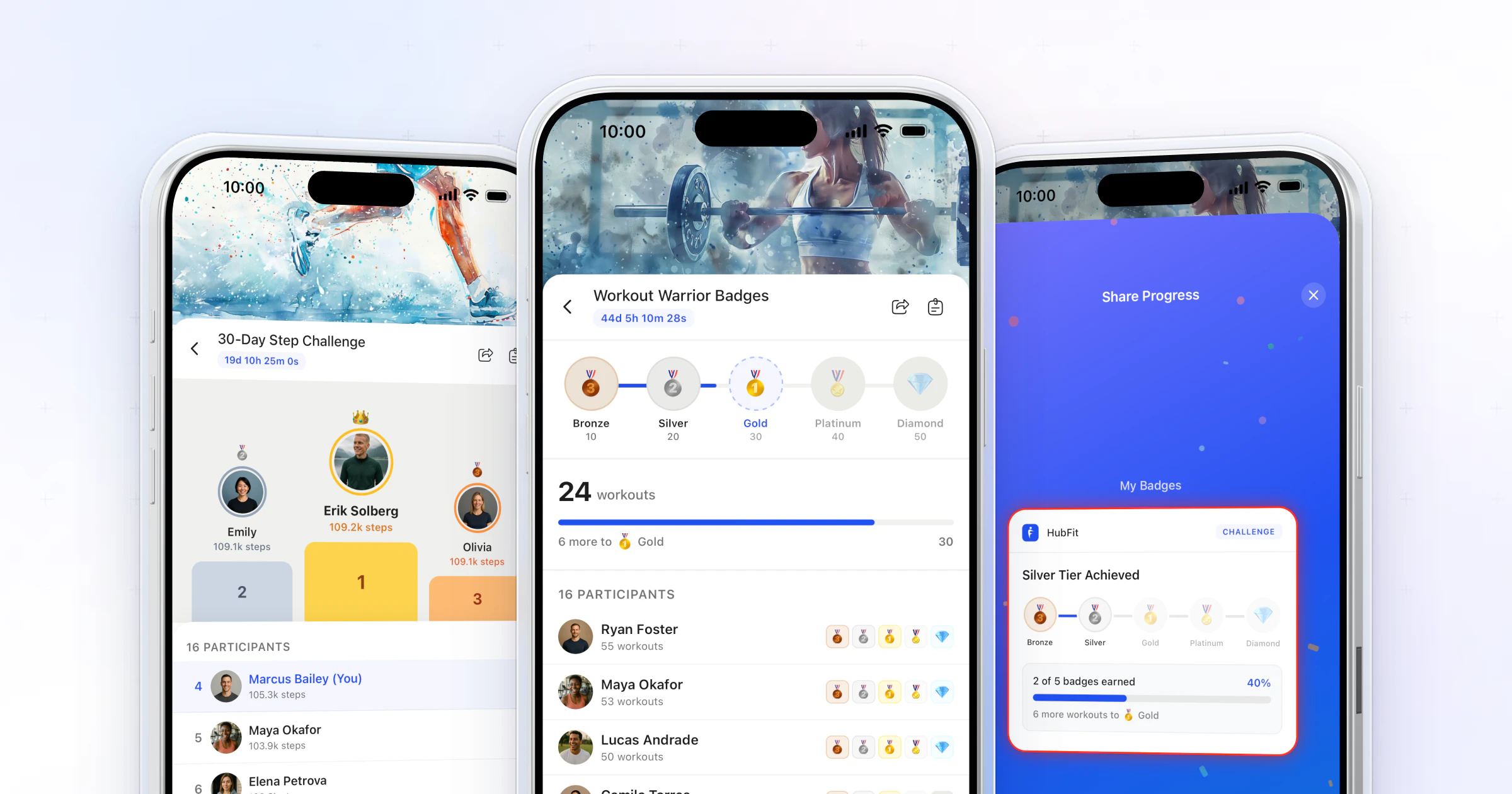
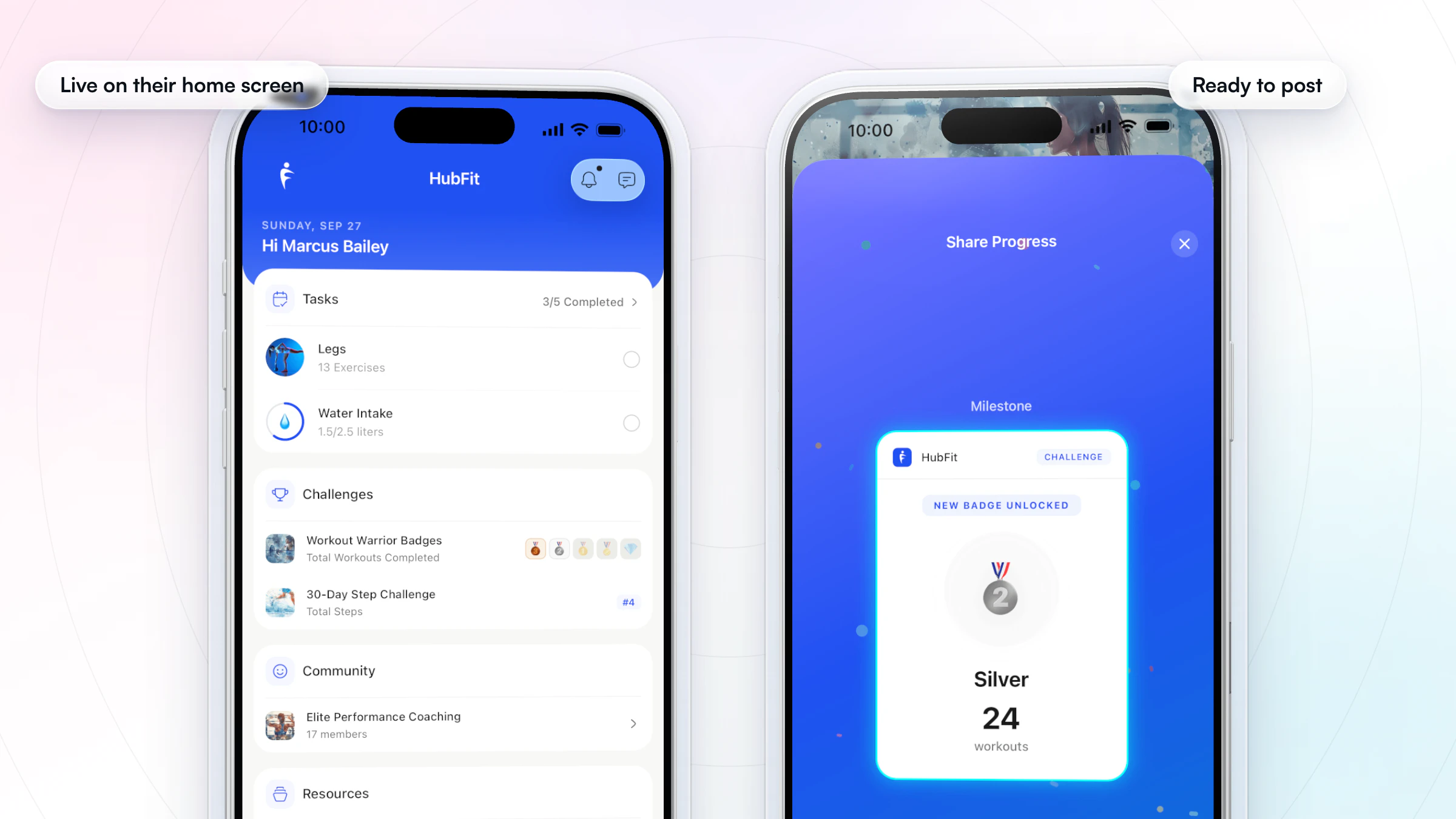
- Announce it, then let the app remind them. Post the launch message below. HubFit pushes Challenge Started, Ending Soon (24 hours before the end) and Complete to every client, and tells you when there's a new leader or a badge is earned, so you don't post reminders by hand. When clients unlock a badge, they can share a branded, Instagram-ready card.
See HubFit challenges for the full feature.
What rewards work?
The best rewards are recognition first and prizes second. A badge earned in public, a shout-out in the group and a share card a client posts do more than a gift card.
If you add a prize, keep it tied to coaching: a free form check, a bonus program or a month of coaching for a winner drawn from everyone who reached Tier 3. A draw keeps beginners in the race.
A 12-month challenge calendar
A 12-month challenge calendar keeps one challenge running at a time and changes the behavior every month. Copy it and adjust to your clients.
| Month | Challenge | Why then |
|---|---|---|
| January | 30-day training commitment | New clients, new routines |
| February | Protein Priority | Carries January's momentum to meals |
| March | 100K Step Week | A short spark in a long quarter |
| April | Daily mobility | Spring sports and running season |
| May | Iron Lifter | Strength block before summer |
| June | Outdoor 20 | Long days |
| July | Water habit | Heat and travel |
| August | Personal best month | Retest after the summer block |
| September | 30 Days of Tracking | Back to routine |
| October | Consistent bedtime | Darker evenings |
| November | Holiday hold | Thanksgiving to New Year |
| December | No zero days | Ten minutes still counts |
Run two at most at once, and never two leaderboards. Too many at once is one of the reasons why most coaching challenges fail.
A copy-paste launch message for your clients
A launch message needs four things: the name, the rule, the dates and the first win. Use this copy-paste launch message and swap the details.
Our next challenge starts Monday: Protein Priority. For 30 days, every day you hit your protein target counts. Your food log does the scoring, so just log as you already do. Your first badge comes at 5 days. Two grace days are built in, so one off day won't end it. Reply with your go-to high-protein breakfast and I'll share the best ones on Friday.
If you run your coaching on HubFit, the challenge, the scoring and the badges are already in the app your clients use.
FAQ
These are the questions coaches ask most before they launch their first challenge.
What is a fitness challenge?
A fitness challenge is a short, time-boxed goal a group works toward with one clear rule for what counts, such as 100,000 steps in 7 days or 20 workouts in 30 days. It sits on top of a client's program and adds a deadline, a score and a group to keep them consistent.
How long should a fitness challenge last?
Most fitness challenges should last 7 to 30 days. Use 7 days for a quick spark, 14 to 21 days to build one new habit and 30 days for consistency. A 60-day challenge suits committed groups only. Habits often take longer than 30 days to feel automatic, so run a series instead of one long challenge.
How do you start a fitness challenge?
Start a fitness challenge by picking one behavior your clients struggle with, then choosing a mode (leaderboard or milestones), a length and the rule for what counts. Set an easy first tier, announce it with clear dates and track it automatically from data clients already log, like workouts, food logs or synced steps.
What are good fitness challenge ideas for beginners?
Good fitness challenge ideas for beginners are a step ladder that rises from 5,000 steps a day, a 30-day training commitment with the first badge set at 4 workouts, and a daily 10-minute mobility habit. Use milestones, not a leaderboard, so beginners compete only with themselves and earn a win in the first week.
What prizes work for a fitness challenge?
Recognition works better than expensive prizes. Badges, a shout-out in your group and a share card clients can post keep people engaged. If you add a prize, tie it to coaching, like a free form check or a bonus program, and draw a winner from everyone who reached a set tier so beginners stay in.
What makes a fitness challenge engaging?
A fitness challenge is engaging when it has one clear rule, a first win in week one, a score clients can see, a group to share it with and a short end date. Remove any of those and interest fades by week two. Recognition in the group keeps people going more than a prize.
What are fun fitness challenge ideas for groups?
Fun group ideas are fitness bingo, a virtual route where badge tiers are checkpoints, a team step relay and a class passport. Each gives the group a shared story to talk about. Keep teams mixed, post the totals weekly and celebrate effort as loudly as the winners.
Can you run a fitness challenge online?
Yes. Online, a challenge works best when it's scored from what clients already log. In HubFit, workouts, food logs and synced steps keep the score, and every client gets a push when it starts, 24 hours before it ends and when it's complete.
What are some ideas for a work fitness challenge?
Good work fitness challenge ideas are a team step relay, a take-the-stairs week, a daily mobility break and a screens-off-before-bed habit. Teams of 3 or 4 with mixed fitness levels keep it fair. Score steps automatically from phones, and keep body weight and calories off any shared leaderboard.
Launch your first challenge this week
Pick one idea from the table, set the first badge so everyone earns it in week one, and send the launch message on Monday.