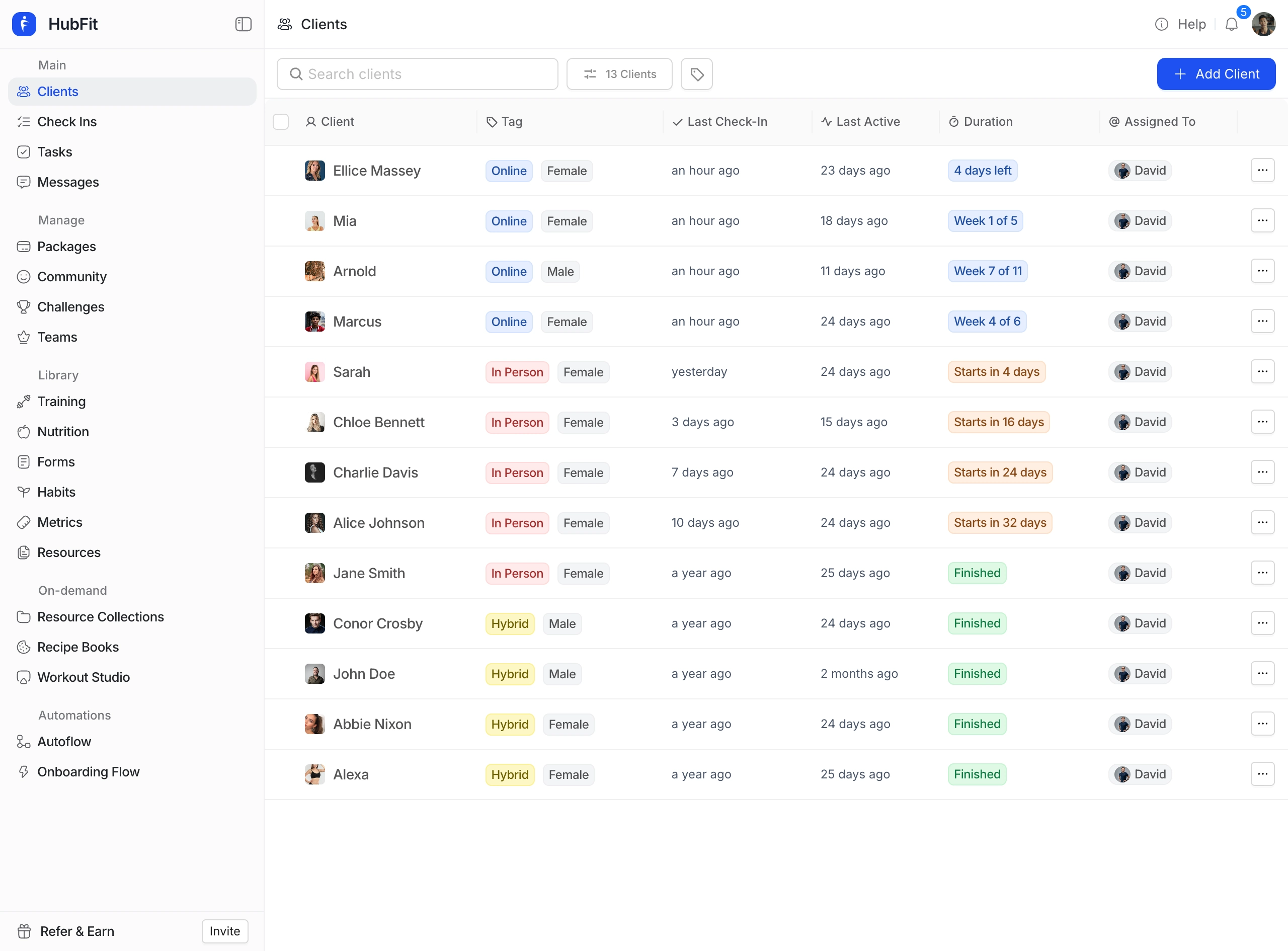
To calculate macros, estimate daily calories (Mifflin-St Jeor BMR times an activity factor), adjust for the goal, then set protein from body weight, fat at 20 to 35% of calories and carbs from the rest. Protein and carbs carry 4 calories a gram, fat 9. Coaches using HubFit put those targets in each client's app, with a separate rest-day goal, and clients can set their own too.
Want the numbers in seconds? Our free macros calculator runs steps 1 to 3 for you. The steps below show how it works, and what to do with the numbers once a client starts logging.
Key takeaways
- Macros come from calories. Get the calorie target right first; the split only decides where those calories come from.
- Set protein from body weight, not as a percentage. A percentage split can leave a heavier client on a deficit short of protein.
- Fat takes 20 to 35% of calories. Carbs get the rest.
- Every target is an estimate. The weekly average and the weight trend tell you what to change after two to three weeks.
How to calculate macros in 6 steps
Calculating macros takes six steps and about ten minutes by hand. Here is the method with a worked example: a 35-year-old woman, 165 cm (5 ft 5 in) and 70 kg (154 lb), who lifts three to four times a week and wants to lose fat.
| Step | What you work out | Method | Example result |
|---|---|---|---|
| 1 | BMR (calories at rest) | Mifflin-St Jeor | 1,395 kcal |
| 2 | TDEE (with activity) | BMR × 1.55 | 2,162 kcal |
| 3 | Goal calories | TDEE − 500 | 1,660 kcal |
| 4 | Protein | 1.8 g × 70 kg | 126 g (504 kcal) |
| 5 | Fat | 25% of calories ÷ 9 | 46 g (414 kcal) |
| 6 | Carbs | Calories left ÷ 4 | 185 g (740 kcal) |
Check the answer by converting back: 504 + 414 + 740 = 1,658 kcal, within a few calories of the target. Each step's full formula is in its own section below, so you can run it for any client.
What are macros?
Macros (macronutrients) are the three nutrients that supply most of the calories in food: protein, carbohydrate and fat. Each gram carries a fixed number of calories, known as the general Atwater factors, which the USDA's Handbook 74 sets out.
| Nutrient | Calories per gram | What it does for a client who trains |
|---|---|---|
| Protein | 4 | Builds and repairs muscle |
| Carbohydrate | 4 | Fuels hard training |
| Fat | 9 | Hormones, vitamins A, D, E and K |
| Alcohol | 7 | Calories only, no macro |
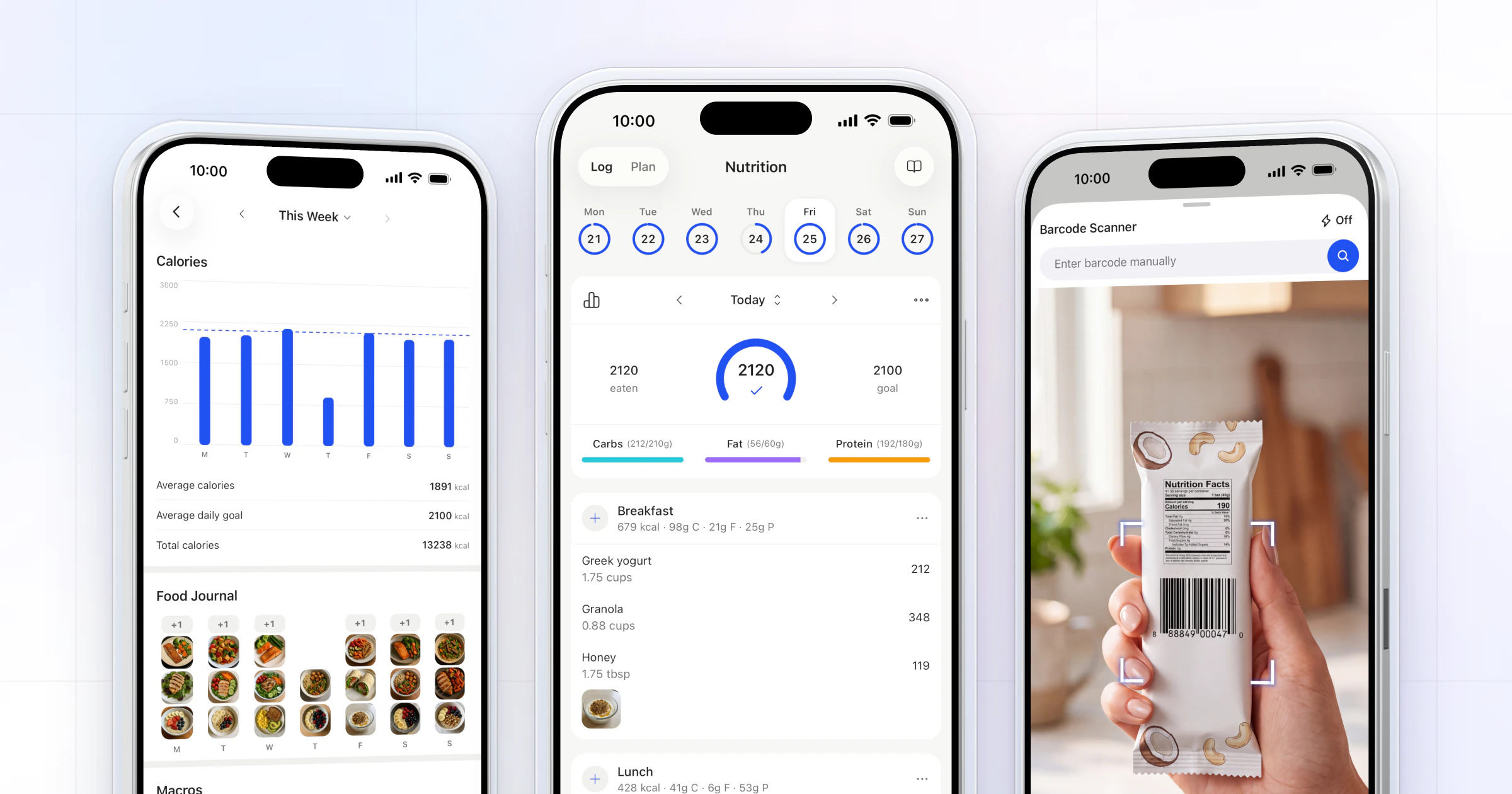
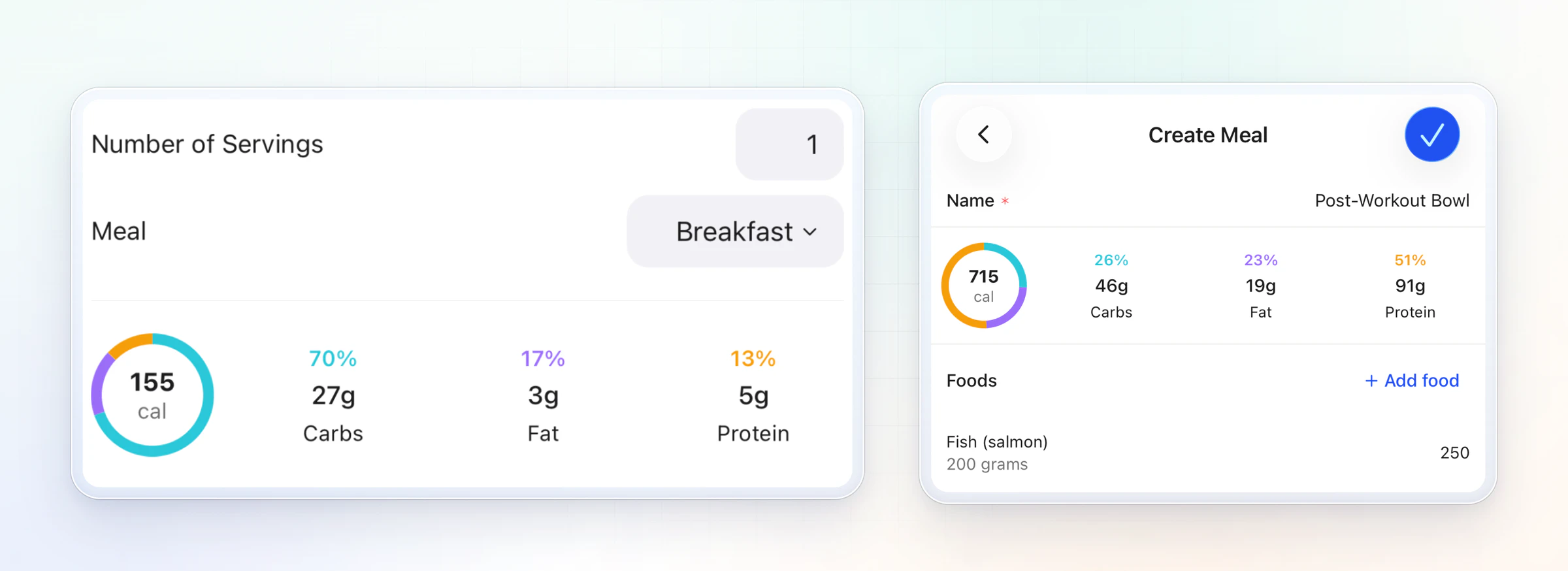
Those four numbers turn calories into grams (divide) and grams back into calories (multiply). Try them on a real log. A breakfast serving of oatmeal at 27 g carbs, 3 g fat and 5 g protein is 108 + 27 + 20 = 155 calories, exactly what the app shows. A post-workout bowl the client is building at 46 g carbs, 19 g fat and 91 g protein works out to 719, within rounding of the 715 on screen.
Step 1: How do you calculate BMR?
BMR (basal metabolic rate) is the calories the body burns at rest, and the Mifflin-St Jeor equation is the standard way to estimate it. It was built from 498 healthy adults (Mifflin et al., 1990):
- Men: 10 × weight (kg) + 6.25 × height (cm) − 5 × age + 5
- Women: 10 × weight (kg) + 6.25 × height (cm) − 5 × age − 161
Working in pounds and inches? Divide pounds by 2.205 to get kg and multiply inches by 2.54 to get cm. A 2005 review found Mifflin-St Jeor predicted resting metabolism within 10% of the measured value more often than the other common equations.It is still an estimate, so treat the result as a starting point. Our BMR calculator runs the same equation.
For our client: 10 × 70 + 6.25 × 165 − 5 × 35 − 161 = 1,395 kcal.
Step 2: How do you find TDEE?
TDEE (total daily energy expenditure) is BMR multiplied by an activity factor that covers training, work and daily movement. These are the multipliers most calculators use, including our TDEE calculator:
| Activity level | What it looks like | Multiplier |
|---|---|---|
| Sedentary | Desk job, little or no exercise | 1.2 |
| Lightly active | Light exercise 1 to 3 days a week | 1.375 |
| Moderately active | Exercise 3 to 5 days a week | 1.55 |
| Very active | Hard exercise 6 to 7 days a week | 1.725 |
| Extra active | Physical job plus hard training | 1.9 |
Our client trains three to four times a week at a desk job, so 1,395 × 1.55 = 2,162 kcal. When in doubt, pick the lower level. People overrate how active they are, and the scale will tell you within a few weeks.
Step 3: How many calories for fat loss or muscle gain?
Goal calories are TDEE minus a deficit for fat loss or plus a surplus for muscle gain. A 500-calorie deficit and a 300-calorie surplus are common starting points, and they are what our macros calculator uses. Our calorie deficit calculator shows other deficit sizes.
The better test is the rate. A 2014 review of contest preparation recommends losing about 0.5 to 1% of body weight a week to keep muscle.For our 70 kg client, that is 0.35 to 0.7 kg (about 0.8 to 1.5 lb) a week. Start at 2,162 − 500 = 1,660 kcal (rounded), then check the trend against that range.
Step 4: How much protein do you need?
Set protein first, from body weight: 1.6 to 2.0 g per kg (about 0.7 to 0.9 g per lb) covers most people who train. The International Society of Sports Nutrition (2017) puts most exercising people at 1.4 to 2.0 g per kg a day.A 2018 meta-analysis found muscle gains from extra protein leveled off at about 1.62 g per kg.
- Fat loss: aim for the upper end (1.8 to 2.0 g/kg). Protein helps hold on to muscle in a deficit.
- Maintenance or muscle gain: about 1.6 g/kg is enough.
Our client is in a deficit: 1.8 × 70 = 126 g, or 504 kcal (0.82 g per lb). Want a range for another weight or goal? Use the protein calculator; its fat-loss range runs a little higher than ours.
Step 5: How much fat should you eat?
Set fat at 20 to 35% of calories, the adult range in the Dietary Reference Intakes from the Institute of Medicine (now part of the National Academies).Twenty-five percent is a sensible default. Go lower only in a short, supervised phase.
Our client: 1,660 × 0.25 = 415 kcal ÷ 9 = 46 g of fat (414 kcal).
Step 6: How do you work out carbs?
Carbs fill the calories left after protein and fat. Subtract both from the goal and divide by 4.
Our client: 1,660 − 504 − 414 = 742 kcal ÷ 4 = 185 g of carbs. Her split lands at 30% protein, 25% fat and 45% carbs: inside the National Academies ranges for protein (10 to 35%) and fat (20 to 35%), and a hair under the bottom of the carb range (45 to 65%), at 44.7%.
Worked example: one client, three goals
Here is the same client for each goal, so you can see what changes. Only calories and protein move with the goal; fat stays at a quarter of calories and carbs take the rest.
| Goal | Calories | Protein / fat / carbs | Split of calories (P / F / C) |
|---|---|---|---|
| Fat loss | 1,660 kcal | 126 g / 46 g / 185 g | 30 / 25 / 45% |
| Maintenance | 2,160 kcal | 112 g / 60 g / 293 g | 21 / 25 / 54% |
| Muscle gain | 2,460 kcal | 112 g / 68 g / 350 g | 18 / 25 / 57% |
Protein is 1.8 g per kg for fat loss and 1.6 g per kg for the other two. In pounds: she weighs 154 lb, so that is 0.82 g per lb for fat loss and 0.73 g per lb for maintenance and muscle gain. Notice that protein is highest when calories are lowest. A fixed percentage split would do the opposite.
Protein-first or a percentage split?
A protein-first method gives every client enough protein; a percentage split gives protein as a share of calories, whatever the client weighs. Most calculators use percentages: calories × percentage ÷ calories per gram. HubFit's Smart Meal Planner (Premium and up) shows the math on screen: a 2,000 kcal goal at 40% carbs, 30% protein and 30% fat comes to 200 g carbs, 150 g protein and 67 g fat.
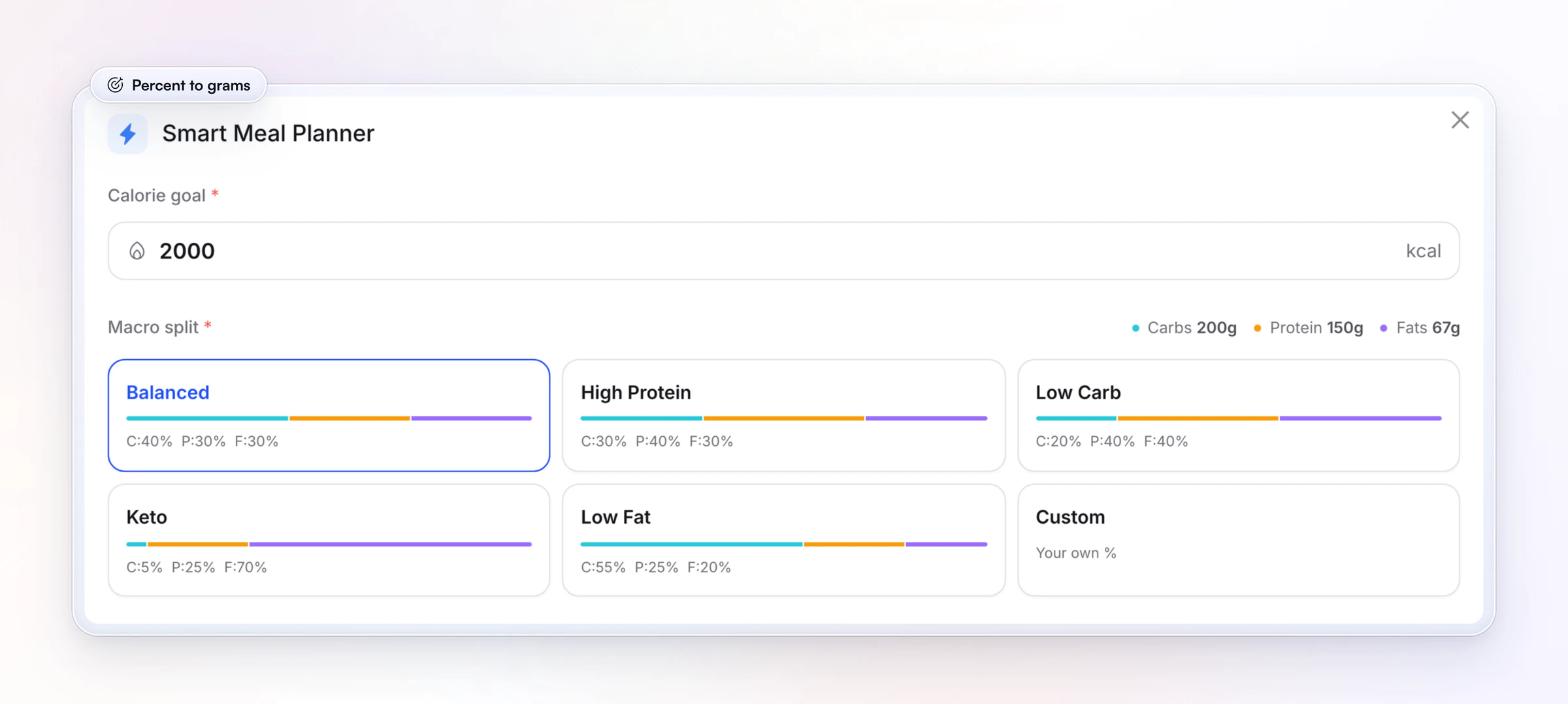
These are the common preset splits, as the planner shows them:
| Preset | Carbs | Protein | Fat |
|---|---|---|---|
| Balanced | 40% | 30% | 30% |
| High protein | 30% | 40% | 30% |
| Low carb | 20% | 40% | 40% |
| Keto | 5% | 25% | 70% |
| Low fat | 55% | 25% | 20% |
Percentages work well near an average body size. At the edges, they miss:
| Client | Calories | 30% protein | Per kg of body weight |
|---|---|---|---|
| 100 kg (220 lb), fat loss | 1,800 kcal | 135 g | 1.35 g/kg, under the ISSN floor |
| 70 kg (154 lb), fat loss | 1,660 kcal | 125 g | 1.79 g/kg, about right |
| 55 kg (121 lb), muscle gain | 2,200 kcal | 165 g | 3.0 g/kg, more than needed |
So set protein from body weight, then use a percentage for fat, and let carbs take the rest. If you like a preset split, check the protein grams against body weight before anyone uses it.
How do you split macros across meals?
Split protein evenly across three to five meals, about 0.25 g per kg of body weight a meal (about 18 g for our 70 kg client), or 20 to 40 g, then spread carbs and fat to suit the client's day. That per-meal dose, every 3 to 4 hours, comes from the ISSN position stand on protein (Jäger et al., 2017).Carbs can lean toward the meals around training; fat can sit where it keeps the client full.
Here is our fat-loss client (126 g protein, 185 g carbs, 46 g fat) over four meals:
| Meal | Protein | Carbs | Fat |
|---|---|---|---|
| Breakfast | 30 g | 45 g | 12 g |
| Lunch | 32 g | 50 g | 12 g |
| Snack | 24 g | 30 g | 8 g |
| Dinner (after training) | 40 g | 60 g | 14 g |
| Day total | 126 g | 185 g | 46 g |
The meals come to 408, 436, 288 and 526 calories: 1,658 in all. If you write the meals themselves, a meal plan template turns these numbers into two options per meal and a grocery list.
Macros in common foods
Knowing the macros in a dozen staples turns grams into meals. These values come from USDA FoodData Central, rounded to the nearest gram; brands and cooking change them a little.
| Food (serving) | Protein | Carbs | Fat |
|---|---|---|---|
| Chicken breast, cooked (100 g) | 31 g | 0 g | 4 g |
| Salmon, cooked (100 g) | 22 g | 0 g | 12 g |
| Egg (1 large) | 6 g | 0 g | 5 g |
| Greek yogurt, nonfat (170 g) | 17 g | 6 g | 1 g |
| Lentils, cooked (1 cup) | 18 g | 40 g | 1 g |
| White rice, cooked (1 cup) | 4 g | 45 g | 0 g |
| Rolled oats, dry (40 g) | 5 g | 27 g | 3 g |
| Potato, baked (1 medium) | 4 g | 37 g | 0 g |
| Banana (1 medium) | 1 g | 27 g | 0 g |
| Almonds (28 g) | 6 g | 6 g | 14 g |
| Peanut butter (2 tbsp) | 7 g | 7 g | 16 g |
| Olive oil (1 tbsp) | 0 g | 0 g | 14 g |
Quality still matters inside the numbers. Two days with the same macros can carry very different amounts of fiber, vitamins and minerals. The National Academies set fiber's Adequate Intake at 14 g per 1,000 calories,so most of the carbs should come from whole grains, beans, fruit and vegetables.
How do you track macros?
Tracking macros means logging what you eat and comparing the daily totals with the targets. Weigh food for the first two weeks, scan packaged food and log as you go rather than at night.
- Weigh, don't guess. A kitchen scale for two weeks teaches what 150 g of rice looks like. After that, most people can estimate.
- Read the label. Grams per serving, then the serving the client actually ate. Teach clients to read nutrition labels once and it sticks.
- Log as you eat. Logging at night means forgetting the snacks.
- Hit protein and calories first. Within a few grams of fat and carbs is close enough.
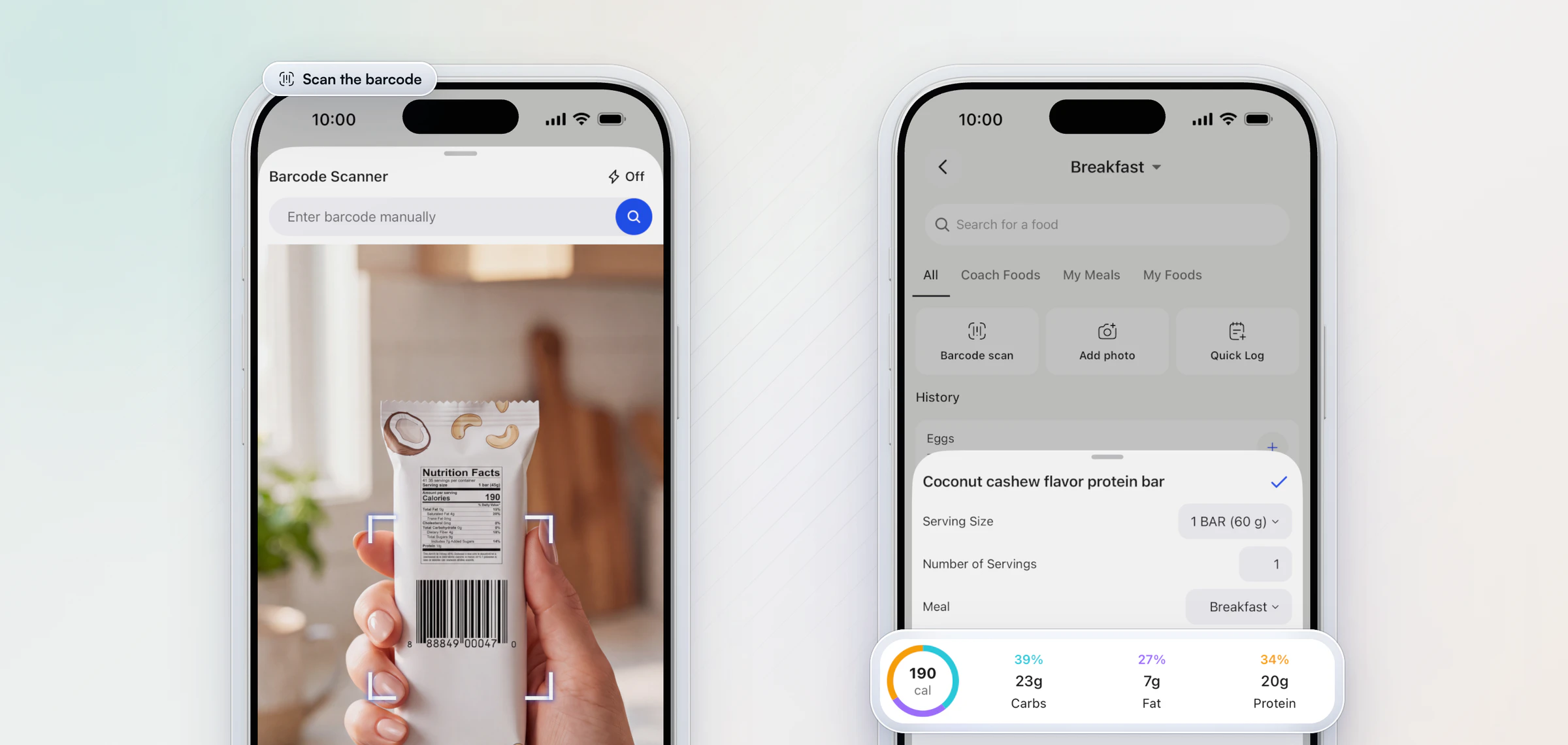
In HubFit, a client logs a packaged food by scanning its barcode, checking that the serving matches what they ate, and adding it to the meal, and the grams count toward the day's targets.
Do you have to count macros?
No, counting every gram is optional. It suits clients with a physique goal who like numbers; many clients do well tracking calories and protein only, or with portions and no app at all. Pick the lightest method that still moves the client toward the goal.
| Method | Effort | Accuracy | Best for |
|---|---|---|---|
| Full macros | High | High | Physique goals, keen trackers |
| Calories and protein | Medium | Good | Most fat-loss clients |
| Hand portions | Low | Moderate | Busy clients, no scale |
| Plate method | Lowest | Rough | Beginners and families |
Hand portions use the client's hand as the measure (a palm of protein, a fist of vegetables, a cupped hand of carbs, a thumb of fat), so the portions grow with the person. The plate method follows the USDA's MyPlate: half the plate fruit and vegetables, a quarter protein, a quarter grains.
How do you adjust macros after the first weeks?
Adjust macros from the weekly average and the weight trend, never from one day. Give new targets two to three weeks before changing anything, then read the week's average against the goal first.
If the average is well off the goal, the numbers have not been tested yet: fix the habit before you change the targets. If the client hits the targets and the trend is off, move calories by 100 to 200 a day from carbs or fat and leave protein alone.
| After 2 to 3 weeks | What it means | What to change |
|---|---|---|
| Average well off the goal | The plan isn't followed yet | Nothing yet: coach the habit |
| On target, losing 0.5 to 1% a week | It's working | Nothing |
| On target, weight flat | The deficit is smaller | 100 to 200 kcal less |
| On target, losing over 1% a week | The deficit is too big | 100 to 200 kcal more, to carbs |
| Gaining, strength flat (muscle gain) | The surplus is too big | 100 to 200 kcal less |
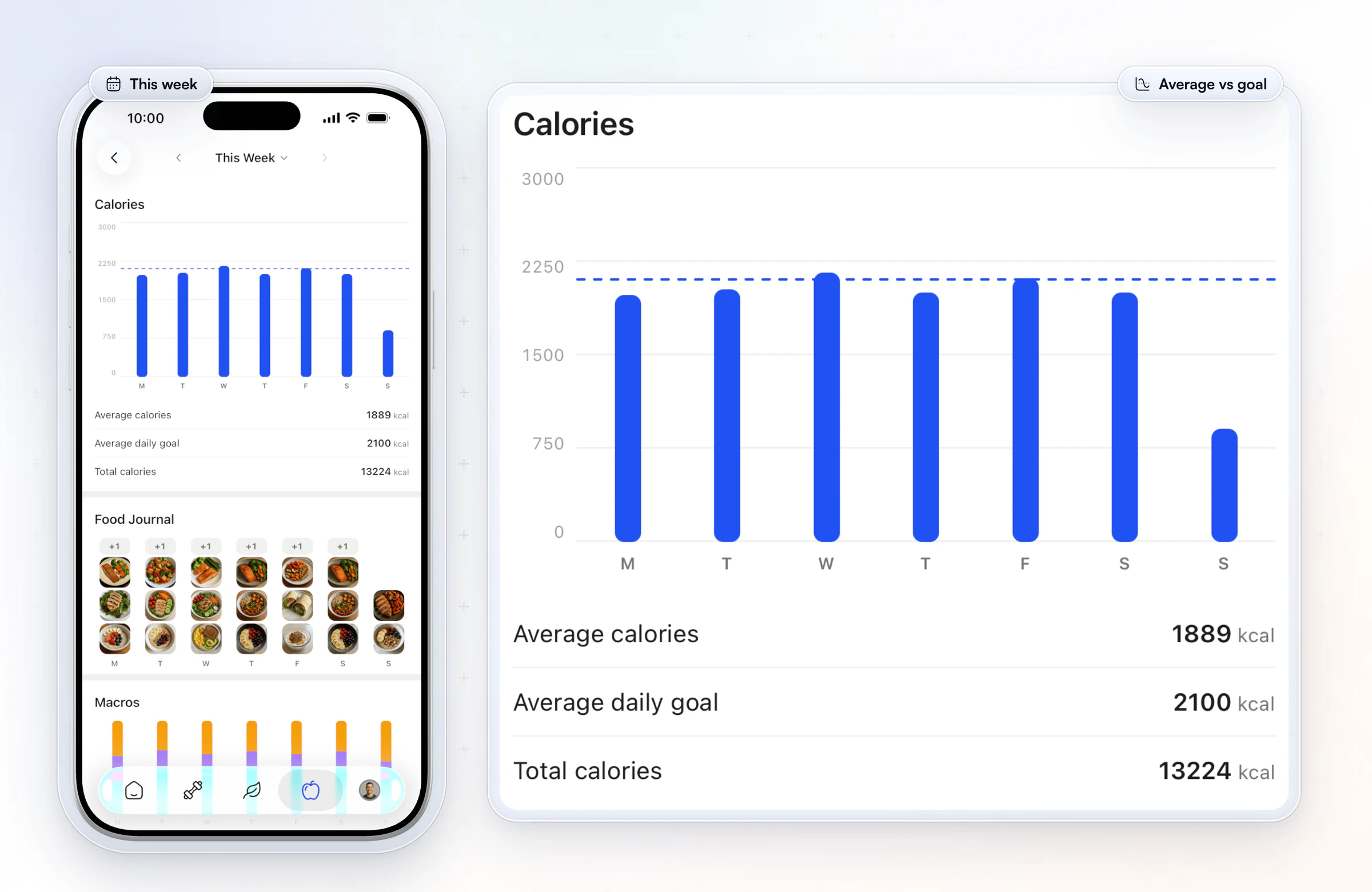
Read the days before the average. In the week below, the client averaged 1,889 calories against a 2,100 goal, which looks like 200 short every day. The bars say otherwise: six days sit close to the goal and Sunday is the low one.So the question is what happened on Sunday, not whether the targets are wrong.
Common mistakes when calculating macros
The most common macro mistakes once logging starts are mixing raw and cooked weights, leaving out oils and drinks, and copying someone else's numbers. The steps above cover the others: protein as a percentage, an inflated activity level and changing targets too soon.
- Mixing raw and cooked weights. Rice, pasta and meat change weight as they cook. Weigh the food in one state and log the entry that matches it: the food table above lists rice cooked and oats dry.
- Leaving out oils, sauces and drinks. A tablespoon of olive oil is 14 g of fat, over 120 calories, and alcohol adds 7 calories a gram that sit in no macro. They are the calories that go missing most often.
- Copying someone else's numbers. A friend's split or a forum's "best macros" were worked out for another body weight, activity level and goal. Run the six steps on the client's own numbers.
Can a coach set macros for a client?
A coach can teach clients how to calculate macros, but setting individual targets is within scope only for those with the right nutrition credential. The American Council on Exercise's guidance on nutrition scope of practice lists individualized meal planning, nutritional assessment and specific intake recommendations among the things fitness professionals should not do, and tells trainers to research their state's laws first.
- Without a nutrition credential: teach this method, share the general guidelines (like the ISSN protein range) and let clients run the math on their own numbers or with our calculator. Coach the habits: logging, protein at each meal, the weekly average.
- With a nutrition credential: set the targets for each client, if your credential and local law allow it.
- Medical conditions, pregnancy or a history of disordered eating: refer to a registered dietitian or the client's doctor. A client with a history of disordered eating shouldn't count anything; coach their training and other habits instead.
Either way, the numbers can live in the client's app. In HubFit, clients can set their own targets, so a coach without a nutrition credential can teach the method and coach the habits while the client owns the math.
How HubFit turns the macro math into a plan clients follow
HubFit puts each step of this method in the app your clients already log in. The numbers they work out, or you set, are the ones they eat to every day and the ones you read before each check-in. Macro targets, meal plans and the tracker are on every plan.
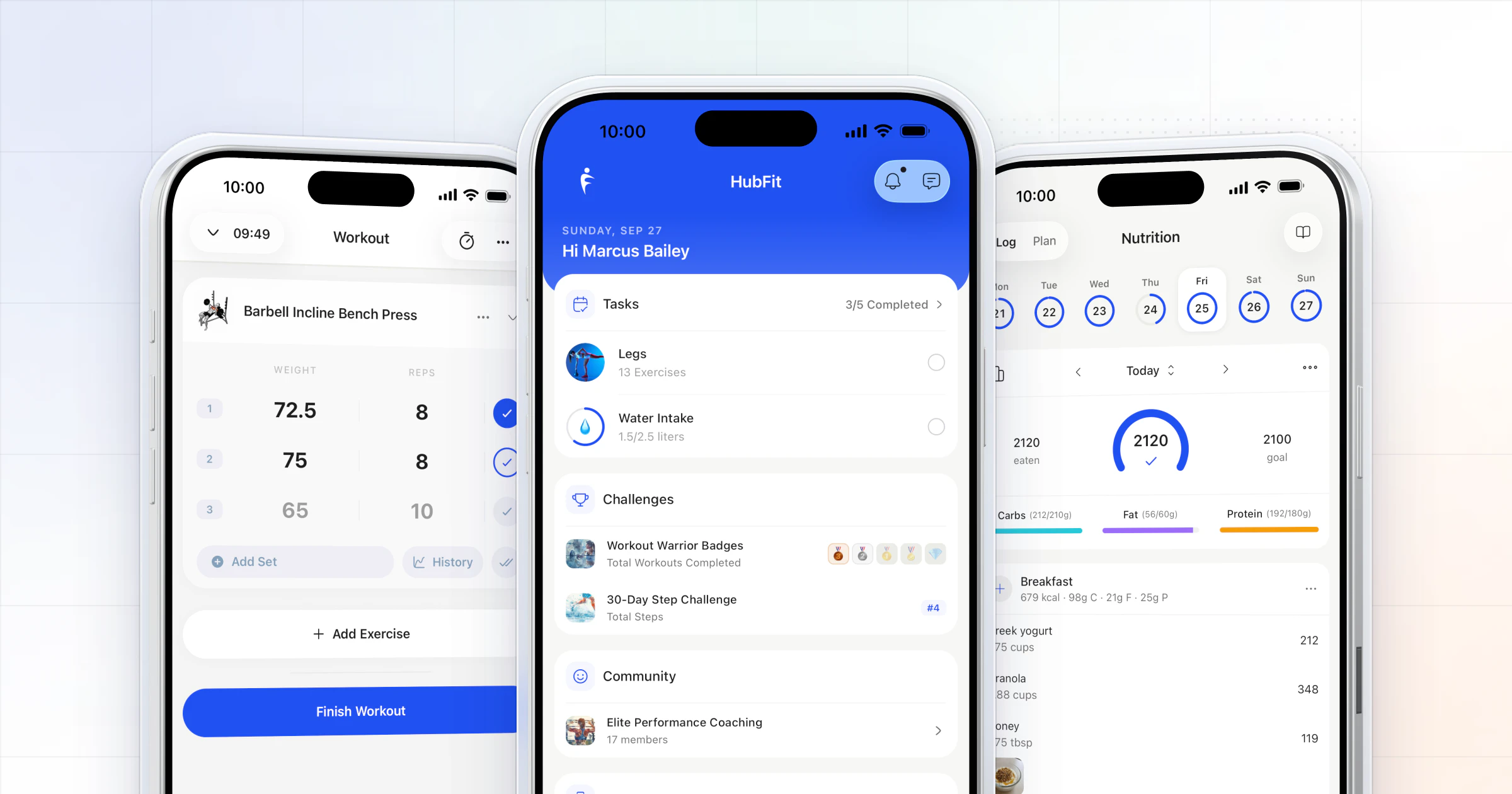
- Clients set their own targets, or you set them. A client who has run the six steps types their calorie, protein, carb and fat goals into the app and logs against them from the next meal. If your credential covers it, you set the goals instead, with a separate goal for rest days.For example, a client's training days might run 210 g carbs, 180 g protein and 60 g fat, with Saturday and Sunday at 150 g carbs and 70 g fat: 1,950 kcal against 2,100.
- The meal table becomes the plan. A Macros by Meal plan gives each meal slot its own protein, carb and fat targets, so the four-meal split above is what the client sees in the app. A meal plan holds up to 10 meal blocks with up to 4 options each, and the Smart Meal Planner builds a full plan from a calorie goal and a split in seconds, with six presets including Custom.
- Logging does the 4-4-9 math for them. The food database is built in, and the barcode scanner works with any barcode, in any country. A meal the client builds from foods shows its calories and macro split as they go, like the post-workout bowl above.
- The weekly average is ready before the check-in. The weekly breakdown puts the average beside the goal with the food journal photos, the read from the adjustment table above, and macro compliance reports show how every client is tracking against their targets.Pair them with the right questions to ask in a nutrition check-in.
For the whole workflow, read how to track client nutrition and our guide to nutrition coaching, or see HubFit for nutrition coaching.
FAQ
These are the questions people ask most about calculating macros.
What is the formula to calculate macros?
Calculate BMR with Mifflin-St Jeor (10 × kg + 6.25 × cm − 5 × age, then +5 for men or −161 for women), multiply by an activity factor of 1.2 to 1.9 for TDEE, and adjust for the goal. Then set protein at 1.6 to 2.0 g per kg, fat at 20 to 35% of calories ÷ 9 (the National Academies range), and carbs as the remaining calories ÷ 4.
How do I calculate my macros for weight loss?
Start from TDEE minus about 500 calories, set protein toward the top of the range (1.8 to 2.0 g per kg, or about 0.8 to 0.9 g per lb), put fat at 25% of calories and give carbs the rest. Then watch the weight trend: losing 0.5 to 1% of body weight a week is the rate a 2014 review recommends for keeping muscle.
What is the 30/30/40 rule for macros?
The 30/30/40 rule is a split of 40% of calories from carbs, 30% from protein and 30% from fat, often written as 40/30/30. It is the Balanced preset in HubFit's Smart Meal Planner. It's a fine starting point for an average-sized adult, but check the protein grams against body weight: at low calories or a high body weight, 30% can fall short.
What should my macros be for 1,500 calories a day?
It depends on body weight, because protein comes first. For a 70 kg (154 lb) person: 126 g protein (1.8 g per kg, 504 kcal), 42 g fat (a quarter of calories, 378 kcal) and 154 g carbs (616 kcal), for 1,498 kcal in total. A heavier person needs more protein and fewer carbs at the same calories.
How do you calculate calories from macros?
Multiply the grams of each macro by its calories per gram and add them up: protein × 4, carbs × 4, fat × 9 (and alcohol × 7 if there is any). For example, 180 g protein, 210 g carbs and 60 g fat is 720 + 840 + 540 = 2,100 calories.
How long does it take to see results from counting macros?
Give new targets two to three weeks before you judge them, then read the weekly average and the weight trend together. At the rate a 2014 review recommends for fat loss, 0.5 to 1% of body weight a week, one week's change hides inside daily water swings, so three to four weeks of trend is the fair test.
Should macros be different on rest days?
They can be. Protein stays the same every day, because it comes from body weight. Carbs can drop on rest days, since there is no hard session to fuel, with fat a little higher or calories a little lower. HubFit lets you set a separate rest-day goal, like the example above at 1,950 calories against 2,100 on training days.
What are good macros for a low-carb or keto diet?
A ketogenic diet usually keeps carbs at about 50 g a day or less (around 10% of calories), as the ISSN position stand on diets and body composition describes it.Protein still comes from body weight, and fat fills the rest of the calories. Low-carb diets that aren't ketogenic simply sit below the usual 45% carb share.
Worked out a client's numbers? Put them where the client logs: have the client enter their own targets in HubFit this week (or set them yourself if your credential covers it), and read the weekly average against the goal at your next check-in.