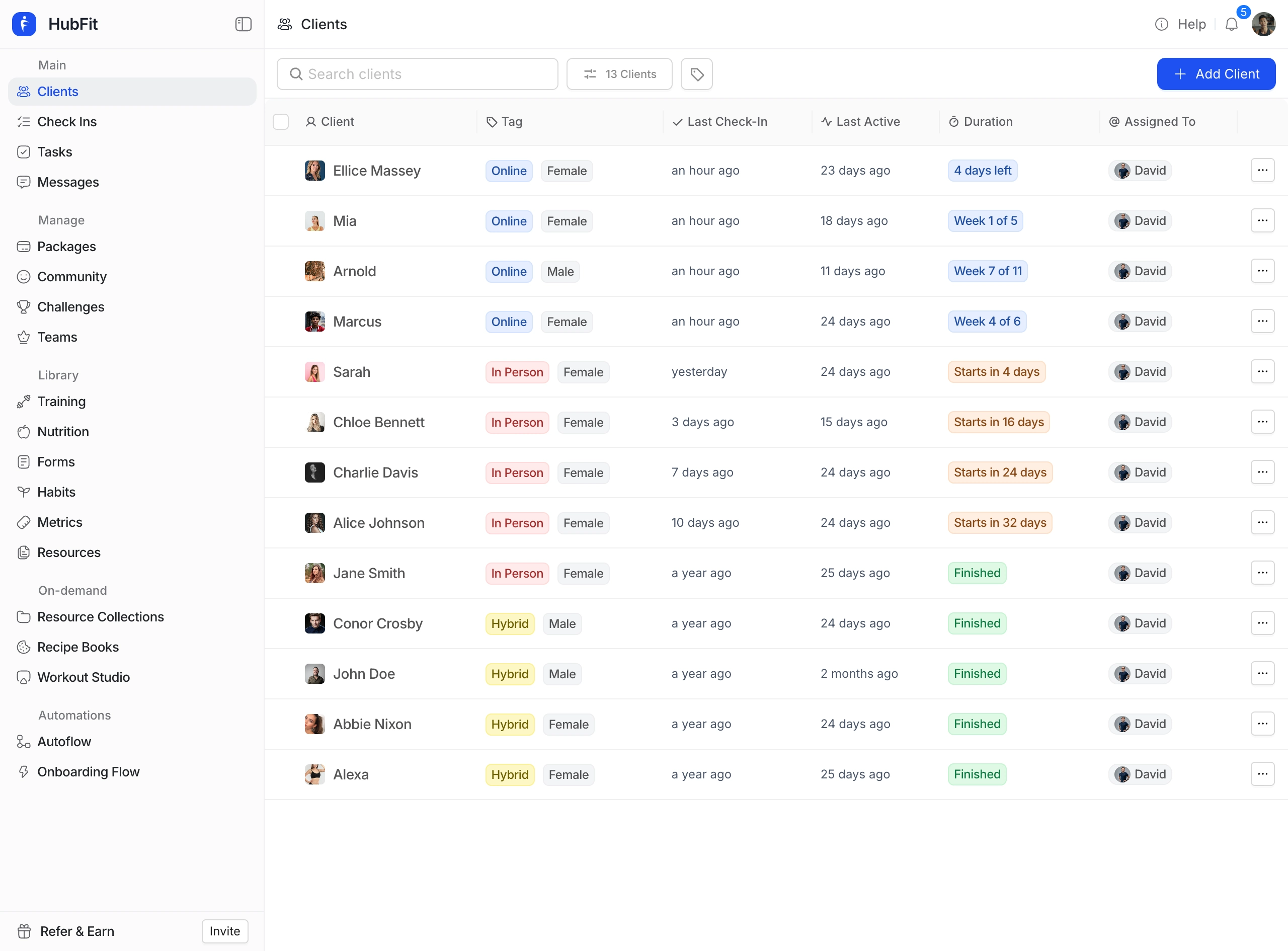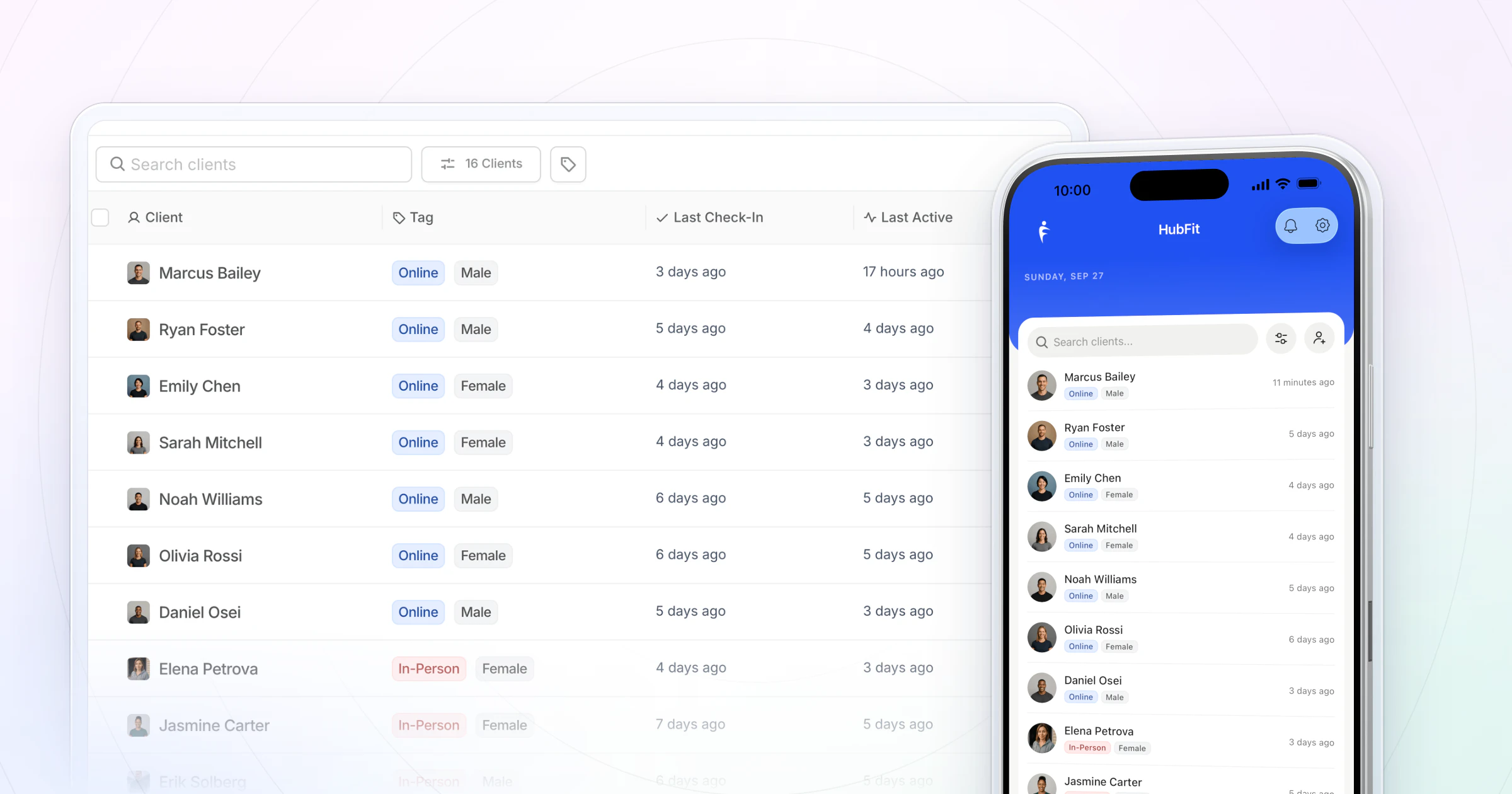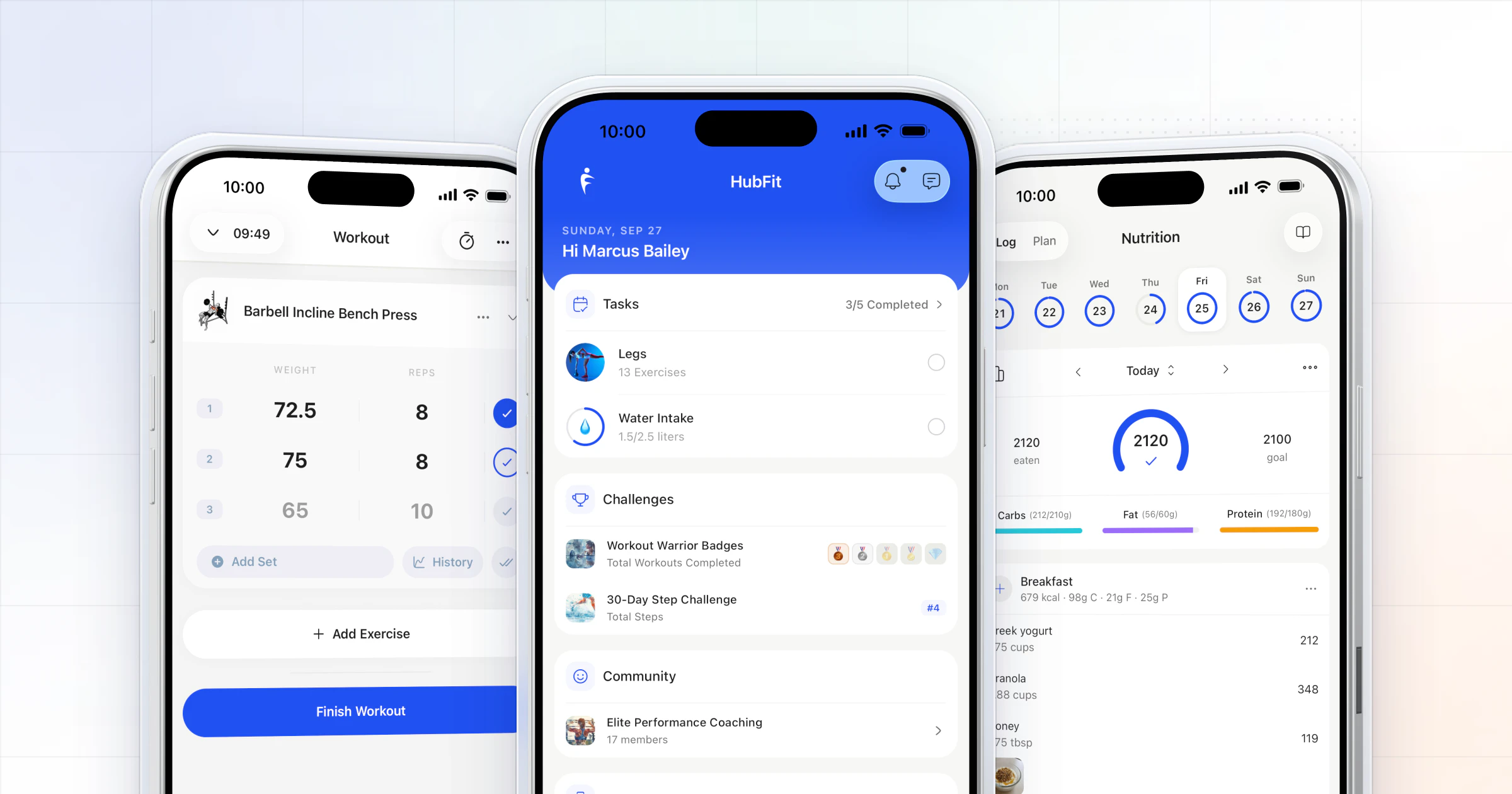
You build confidence as a new personal trainer by getting very good at a few basics, rehearsing the moments that make you nervous, learning from a mentor and keeping proof that your coaching works. Most nerves come from feeling unprepared and disorganized, not from a lack of knowledge. HubFit handles the organized part: programs, check-ins and client progress in one professional app from your first client.
Key takeaways
- Confidence comes from reps, not certificates. Coach friends, get a mentor's critique, then coach clients.
- Script the moments that rattle new trainers: the first session, a question you can't answer, a mistake on the floor.
- Keep proof. Logged workouts, PRs and check-ins show you and your client that the plan works.
- Look like a pro from day one. HubFit puts programs, check-ins and chat in one app, and it's free for your clients.
Why do new personal trainers lack confidence?
Confidence as a personal trainer is trust in your own ability to coach a client safely and get them results. New trainers lack it because they haven't had enough reps yet, not because they don't know enough. You passed the exam, but you haven't yet seen a client get stronger because of you. Until you have, every session feels like a test.
The doubt has a name. Psychologists Pauline Clance and Suzanne Imes first described the imposter phenomenon: feeling like a fraud despite real evidence of ability. Most new coaches know it well, and it usually points to one of three gaps, each with a fix.
| What it feels like | What's missing | The fix |
|---|---|---|
| "I'll blank on a cue" | Practice | Coach the basics cold |
| "They'll ask me something" | A plan for gaps | Script "I don't know" |
| "Is this even working?" | Proof | Track every session |
How to build confidence as a new personal trainer: 10 ways
Confidence follows competence, so each of these builds one skill you'll use every week. Work through them in order: the first four make you ready, the next three make your sessions feel calm, and the last three keep you improving.
1. Master a small set of basics
You don't need advanced protocols to coach well. You need to coach eight to ten foundational movements so well you could do it half asleep: squat, hinge, push, pull, lunge, carry and a few core exercises. Learn two or three cues for each, the most common faults, and one easier and one harder version. Most beginner clients will spend months on these, and you'll look sharp teaching them.
2. Keep learning on purpose (certification and courses)
Your certification is the floor, not the ceiling, but more certificates only build confidence when each one answers a worry you actually have. Pick the gap that makes you most nervous, study that, and use it with a real client the same month.
| The worry | What to study | When |
|---|---|---|
| "They'll ask about food" | A nutrition course in your scope | First 3 months |
| "I'll get a new mom or a 65-year-old" | A pre/postnatal or older-adult course | When one books |
| "My programs feel random" | Strength and conditioning study | Months 3 to 6 |
| "I can't explain the why" | Anatomy and movement basics | Ongoing |
One course a quarter, applied to a client that month, beats four courses you never use. Knowledge you've tested on a person is knowledge you can say out loud with confidence.
3. Practice on friends, then ask for a critique
Coach five to ten free sessions with friends or family before you charge anyone. Then ask an experienced trainer to watch one of your sessions, or to let you take them through one, and to tell you plainly what to fix.
This works for a reason. Psychologist Albert Bandura's research on self-efficacy found that doing a task yourself builds belief in your ability more than watching others do it. Reading about coaching won't make you confident. Coaching will.
4. Find a mentor and a peer group
A mentor shortens the time it takes to feel competent, because they spot in one session what would take you months to notice. You need two kinds of support: one experienced trainer above you and a few trainers at your level beside you.
- Ask one mentor for something specific. "Can I shadow two of your sessions?" or "Would you watch my squat cueing for 20 minutes?" gets a yes far more often than "Will you mentor me?" Shadow two to four sessions and write down what they say, not only what they program.
- Build a peer group. Three or four new trainers who meet once a month to swap programs, critique a filmed session and share what went wrong. Everyone is learning, so nobody has to look like they already know.
- Collaborate, don't compete. The trainer down the road is a referral source, not a threat. When your schedule is full or a client needs a specialty you don't have, you'll want someone to send them to, and they'll return the favor.
Bring your mentor real material: a filmed set, a program you wrote, a client question you weren't sure about. Specific questions get specific answers.
5. Script your first session
A first session goes well when you've planned every part of it, so plan it like a show. Here's a simple run sheet.
| Stage | What you do | Why it helps |
|---|---|---|
| Before | Send a health and goals form | No surprises on the day |
| Start | Ask about goals and history | They feel heard |
| Middle | Test 3 or 4 basic moves | You see how they move |
| End | Finish on an exercise they nail | They leave with a win |
| Same day | Message, program in their app | You look organized |
The form before the session is two things: a client intake form for goals, schedule and history, and a PAR-Q for health screening, so you know who needs a doctor's clearance before you load a bar. In HubFit, the form is a questionnaire you send from your library, and the program is waiting in their app before they get home.
6. Build rapport: listen more than you cue
Clients trust a trainer who listens, and that trust is what makes you feel confident on the floor. Rapport isn't small talk. It's showing the client you heard them and that you'll remember.
- Ask, then repeat it back. When they tell you their goal, say it back in their own words: "So you want to carry your kids upstairs without your back aching." They'll correct you if you're wrong, and they'll know you listened if you're right.
- One cue at a time. Three cues at once overwhelms a beginner and makes you sound unsure. Give one, watch the next rep, then give the next.
- Learn one personal detail per session. A race they're training for, a kid's game on Saturday. Ask about it next time.
| Say this | Not this |
|---|---|
| "What would make this a win for you?" | "So, what are your goals?" |
| "Push the floor away." | "Knees out, chest up, brace, breathe." |
| "How did the stairs feel this week?" | "Any questions?" |
7. Plan what to say in the hard moments
Most panic comes from a handful of moments, so plan your communication before they happen.
| Moment | What to say |
|---|---|
| A question you can't answer | "I'll check and message you tonight." |
| Pain during an exercise | Stop, refer to a physical therapist |
| A medical diet question | Refer to a dietitian or doctor |
| A missed week | "Here's a shorter plan to restart." |
Then follow through. A trainer who checks and comes back with the answer earns more trust than one who guesses.
8. Track progress you can point to
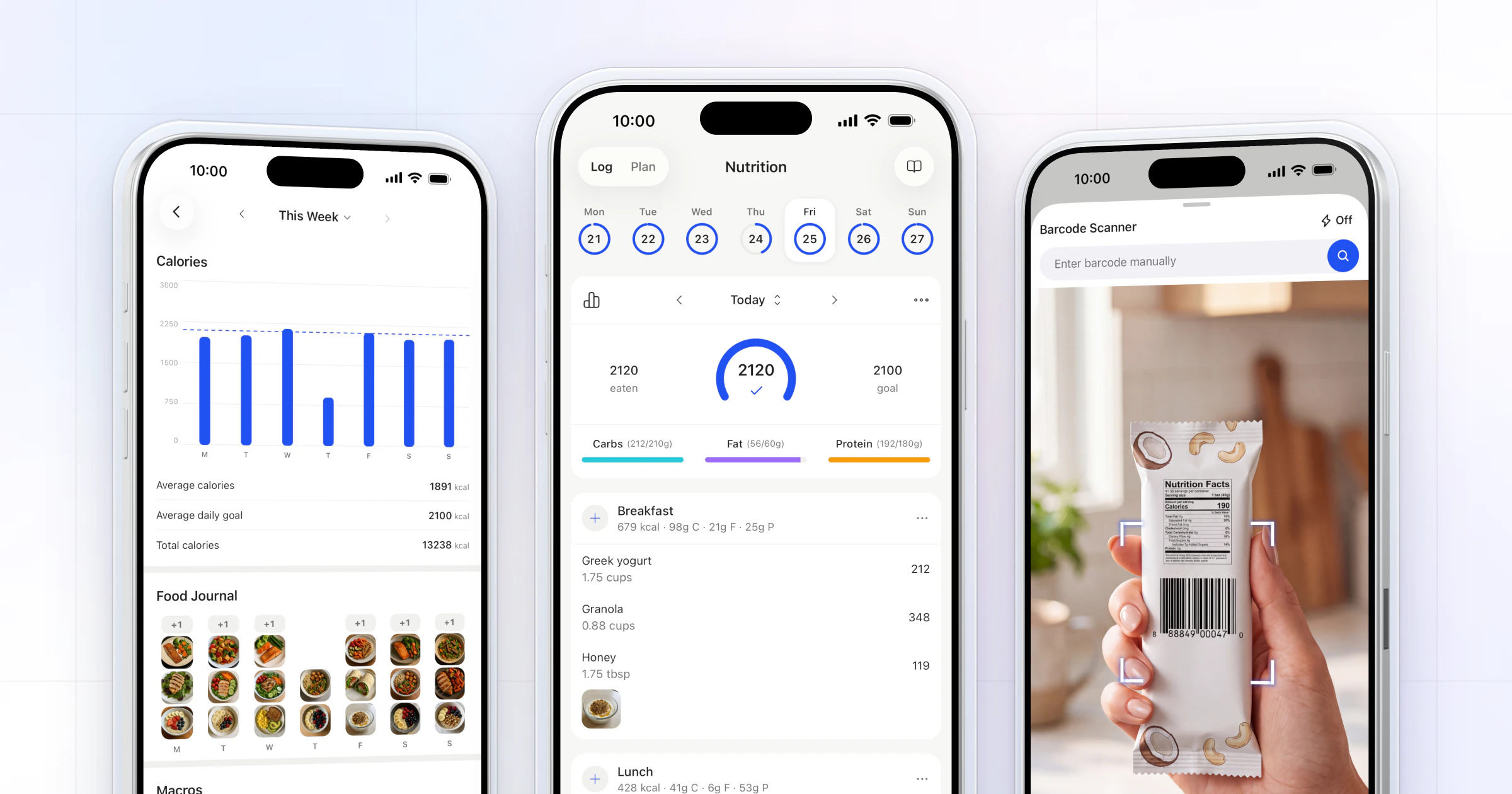
Proof is the fastest confidence builder there is, for you and for your client. Log every session, record weights and reps, and take measurements or photos at regular check-ins. When a client says "I'm not getting anywhere", you open their history and show them the incline bench press that climbed from about 45 kg to 65 kg.
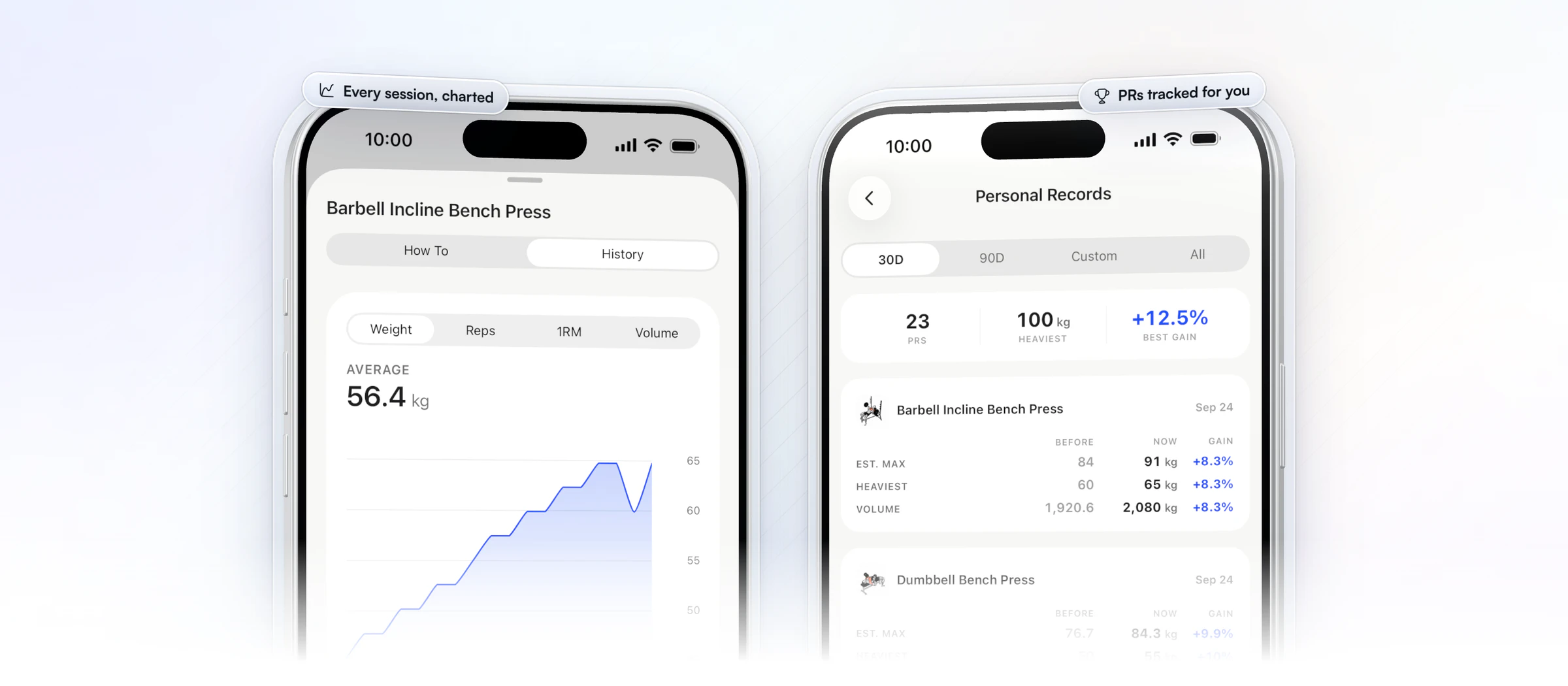
HubFit records every logged set, tracks PRs automatically and charts each exercise's history, so the proof builds itself. Tracked progress is also how you keep clients accountable between sessions, and our guide to client check-ins shows how to set them up.
9. Make your mistakes useful
Every new trainer makes mistakes; confident ones own them in one sentence, fix them and log them so they don't happen twice. Clients don't lose trust over a wrong weight. They lose it over a trainer who pretends nothing happened.
| Mistake | What to say | What to change |
|---|---|---|
| Picked the wrong weight | "Too heavy, let's drop 10 kg." | Start lighter, add a ramp-up set |
| Ran over time | "Sorry, I'll keep us on time." | Time each block in your plan |
| Forgot a client's injury | "My mistake, let's swap this." | Put injuries at the top of notes |
| A cue that didn't land | "Let me say that another way." | Keep two cues per movement |
Then review your week in 15 minutes every Friday:
- Which client made progress this week, and why?
- What mistake did I make, and what's my fix?
- What's one thing I'll do differently next week?
Keep a running wins list too: a client's first push-up, a PR, a kind message. On a bad day, read it. Perfect sessions don't exist. Repeated mistakes do. A short weekly review also helps you avoid burnout as your roster grows.
10. Run your clients like a business from day one
Nothing shakes a new trainer's confidence like a forgotten session, a lost spreadsheet or a client asking where their program went. Put everything in one place before you have ten clients, not after you have thirty. Our guide to how to onboard new clients walks through the first week step by step.
How HubFit helps a new trainer coach with confidence
HubFit gives a new trainer the systems an established one has, so you spend your energy on the client in front of you instead of on admin. It's the #1 coaching app, rated 4.9 on the App Store and Google Play, and your clients get it free, so from your very first session they open a polished app with their program, their check-ins and every number they've hit.
That first impression matters. Jesse Astill of ASTL Performance moved his coaching off spreadsheets into HubFit and now runs it as a premium service.
“I sort of set myself as a premium service which allows me to charge a little bit more and having a clean app where I can upload all my images, all my programs look nice. It's the finer details that allow us to charge a premium.”

Here is what that looks like in a new trainer's week.
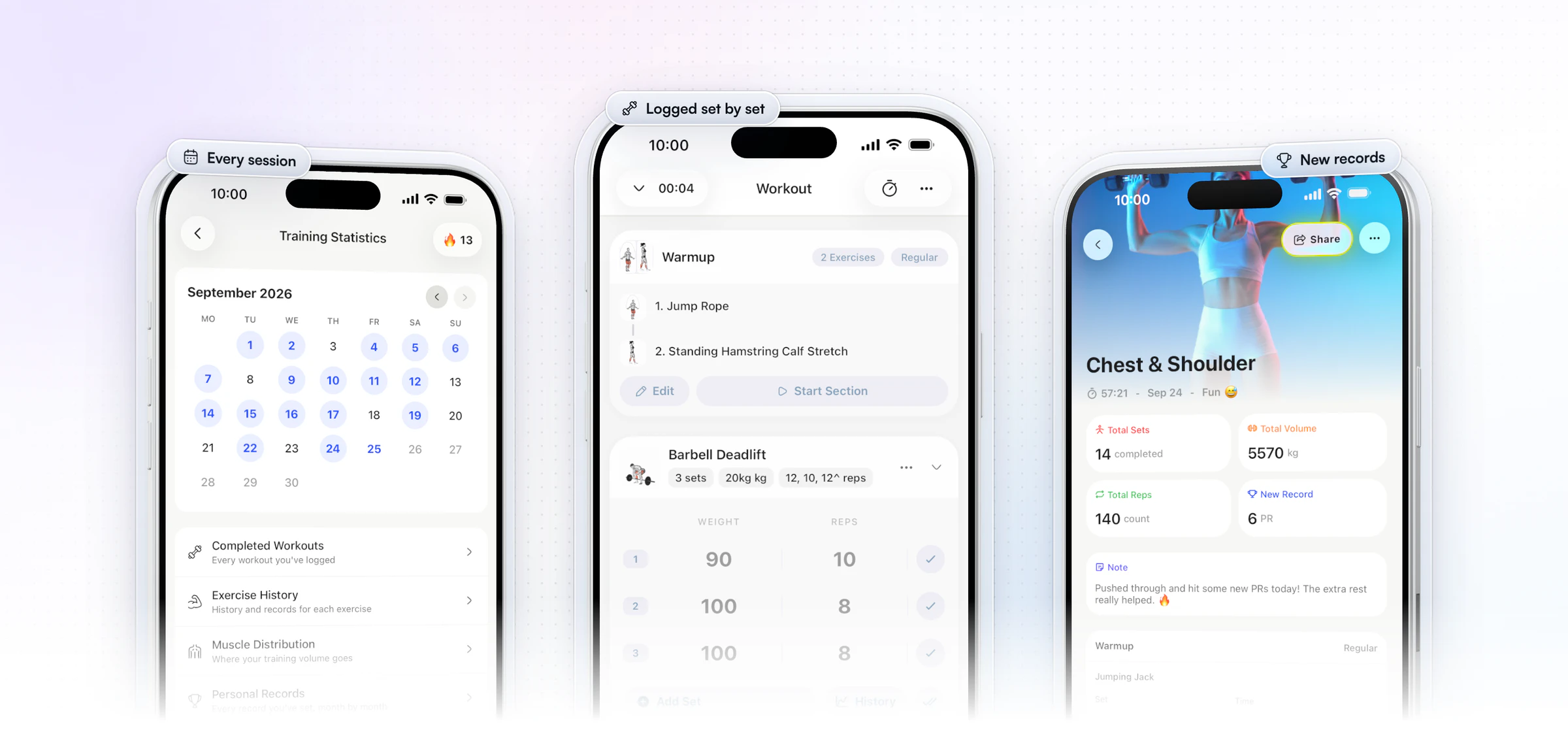
Every set is logged as it happens. You can log a client's sets, reps and weights in the Coach App during the session, in real time, and clients log their own sessions in their app between visits. Nothing lives in your head or on a clipboard, and every program comes with clear demos from a library of 5,000+ exercise videos.
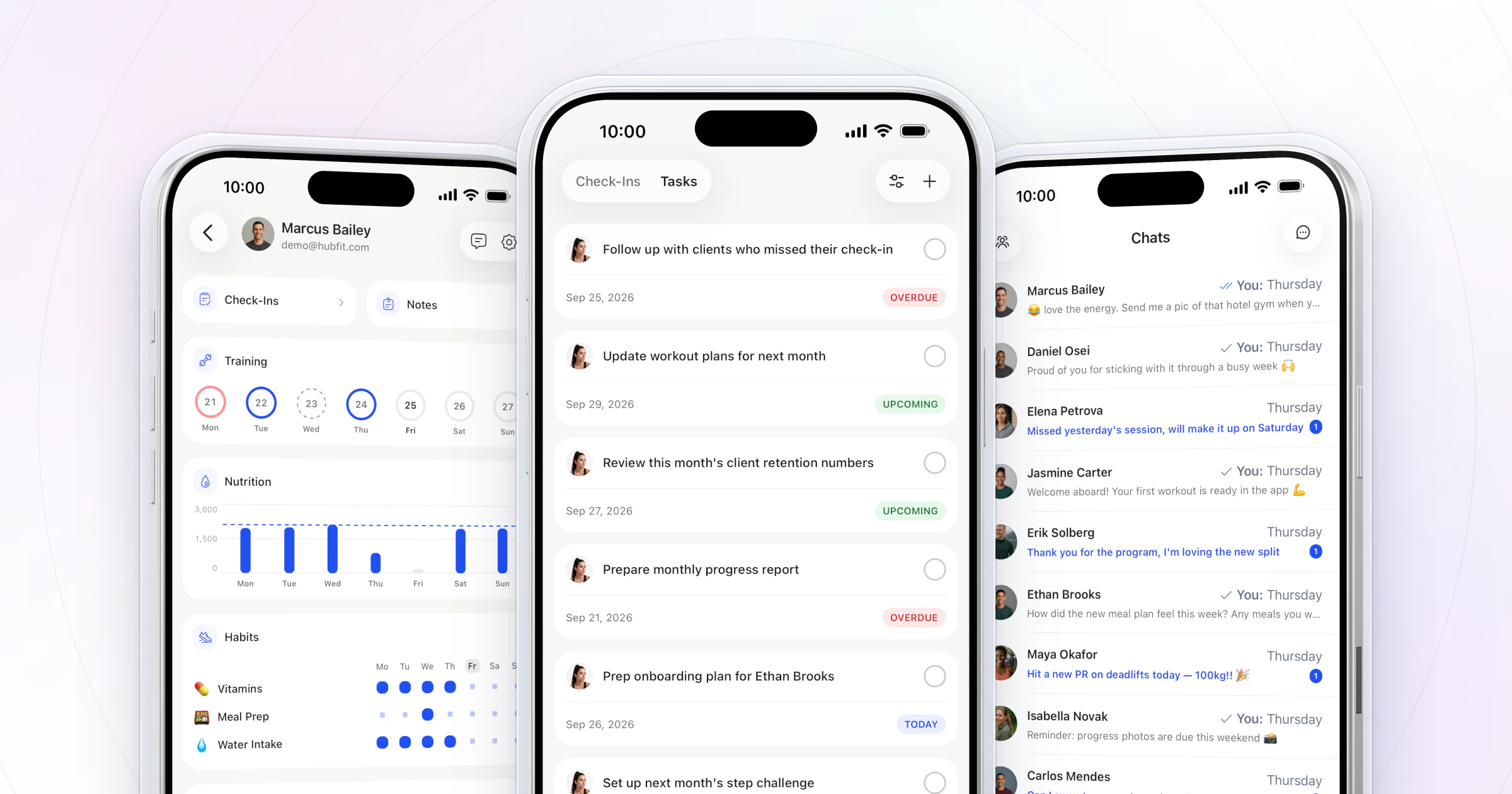
A new client is set up in one go. When you add a client, you pick their questionnaire and an onboarding flow on the same screen, and the flow assigns their program, habits and check-ins straight away. Check-ins then land in one list with what's pending and what you've reviewed, so nobody slips through the cracks while you're busy on the floor.
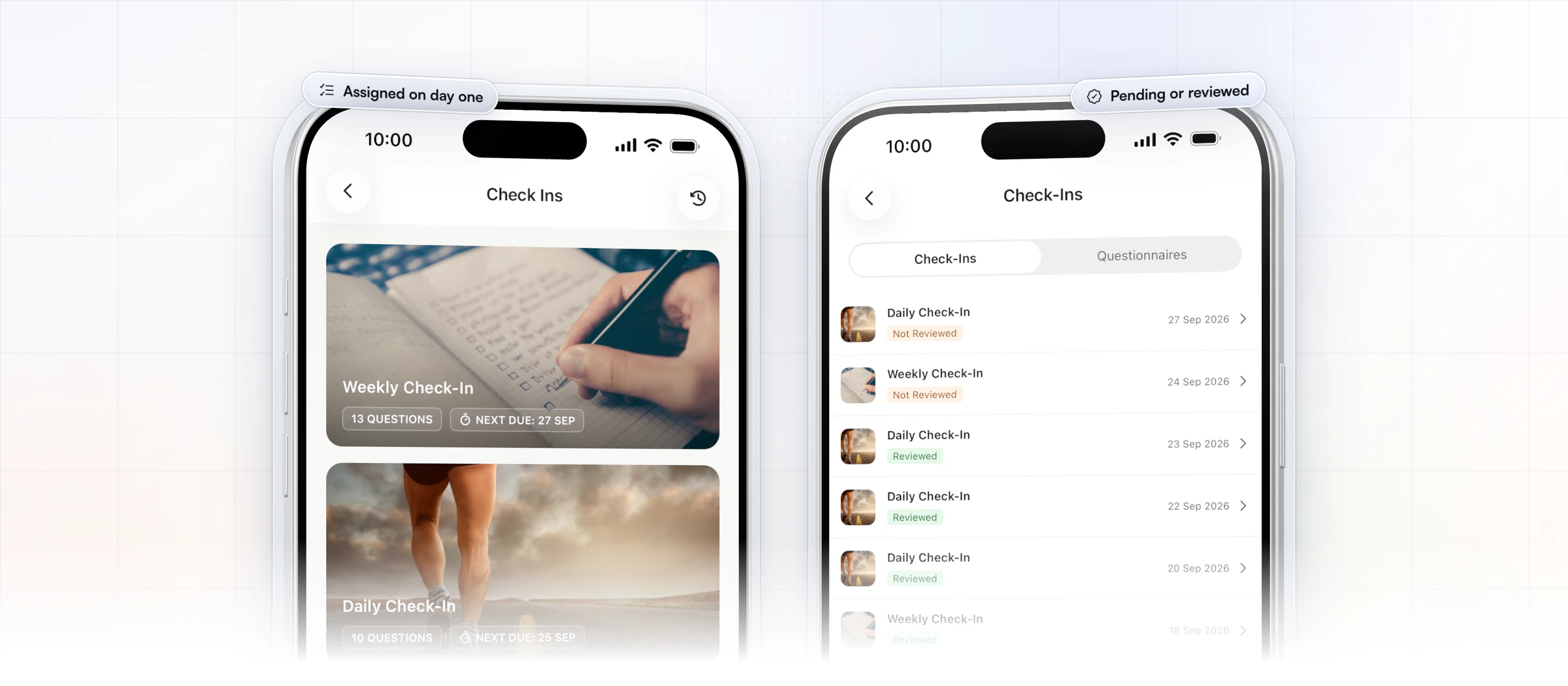
Your feedback reaches them, not your personal number. You answer each check-in with a comment, and the client gets a push and an email when you review it. Day-to-day questions go through 1:1 chat with voice notes, all without giving out your personal number.
Start your free trial and set up your first client this afternoon.
How do you build a professional presence as a new trainer?
A professional presence is a short bio, real proof from clients and a setup that looks organized, and you can have all three before your tenth client. It matters for confidence because people who see you as a professional treat you like one, and that changes how you show up.
- Write a three-line bio. Who you help, how you help them, and your qualification: "I help busy parents get strong in three sessions a week. Strength-based programs you can do at any gym. Certified personal trainer." Our Instagram bio generator for personal trainers gives you a starting point.
- Ask for a testimonial at the right moment. Right after a client's first PR or first month, ask for two sentences in their words, and ask permission before you post it. A real client's words beat any claim you make about yourself.
- Post one thing you taught this week. A cue that clicked, a common mistake, a swap for a cranky shoulder. Teaching builds trust; constant selling doesn't.
- Find your voice. Coach the clients you understand best, in the way you'd explain it to a friend. A clear niche ("new moms getting back to lifting") is easier to talk about than "everyone".
- Look organized. When programs, check-ins and chat live in one app, clients see a professional from the first message. With Custom Branding, your logo, brand name and color appear in the client app, your packages page and checkout, and your logo goes on your emails.
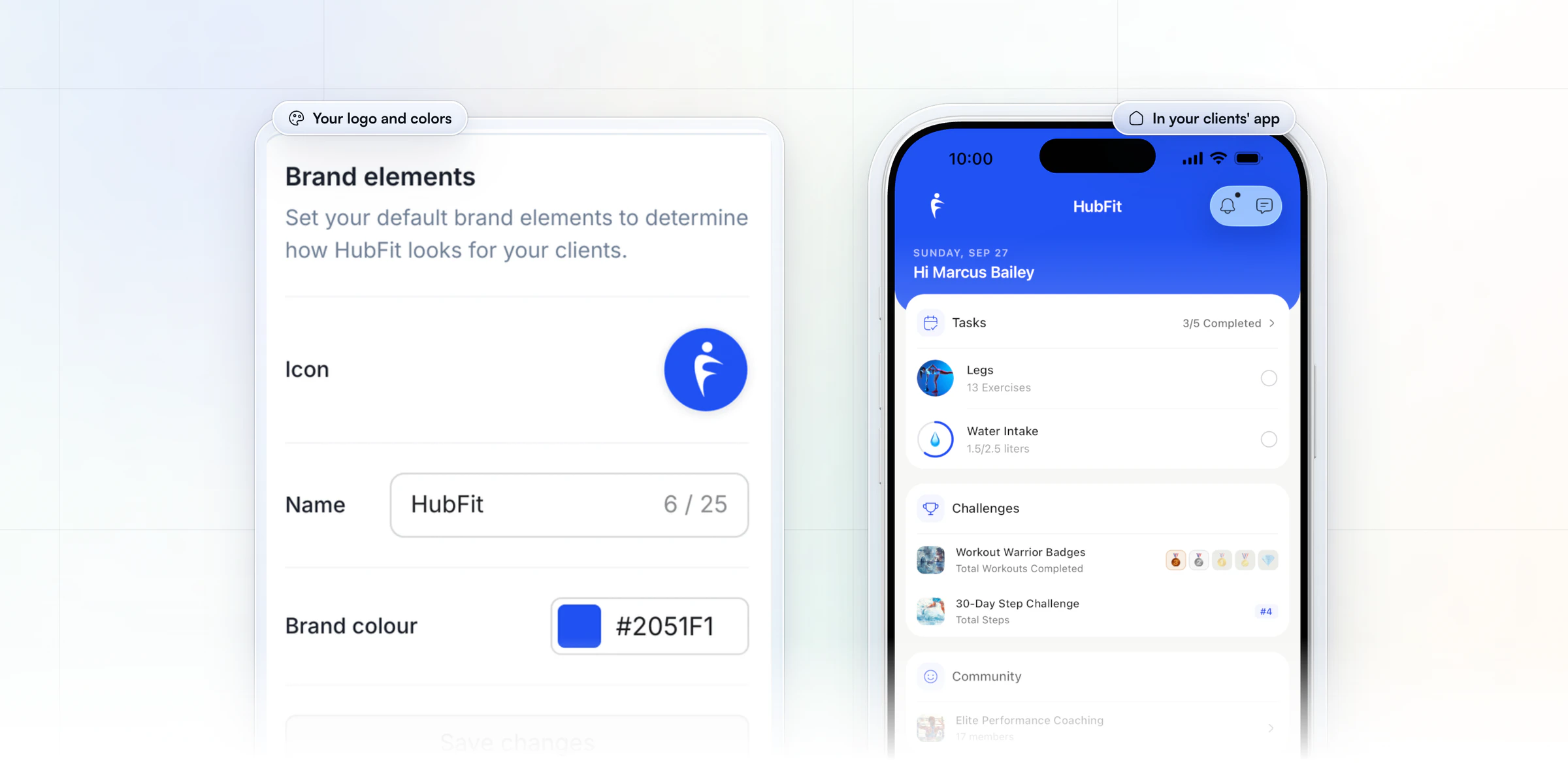
Custom Branding comes with Premium and up.
Your first 90 days: a confidence plan
The fastest way to feel confident is to follow a plan that turns the ten ways above into weekly actions. Here is a 13-week plan for a newly certified trainer.
| Weeks | Focus | Do this | Proof you keep |
|---|---|---|---|
| 1 to 2 | Basics and practice | 5 to 10 free sessions with friends | Notes on what you'd fix |
| 3 to 6 | First paying clients | Use the run sheet every time | Logged sessions and PRs |
| 7 to 10 | Mentor and testimonials | Get one critique, ask for 2 quotes | Mentor notes, client quotes |
| 11 to 13 | Review and level up | Read the wins list, pick a course | A wins list, next course |
At the end of week 13, compare your first session notes with your latest ones. The gap between them is the confidence you've built, written down.
FAQ
Here are the questions new trainers ask most.
How long does it take to feel confident as a personal trainer?
There's no fixed timeline, and the first few months feel shaky for almost everyone. Confidence grows with sessions coached, not weeks passed, so the faster you get reps (practice sessions, a mentor's critique, your first paying clients), the sooner it comes. Follow the 90-day plan and track your wins so you can see it happening.
Is imposter syndrome normal for new personal trainers?
Yes. Feeling like a fraud is common in your first year, and it usually means you care about doing the job well. Answer it with evidence: logged sessions, client PRs and check-ins that show progress. Proof quiets the doubt better than positive thinking does.
How do I calm my nerves before my first personal training session?
Rehearse your run sheet out loud the day before and plan the first five minutes word for word. Arrive 15 minutes early, set up the space, and start with questions, not exercises. Once the client is talking about their goals, the session has started and the nerves usually fade.
What if a client knows more than I do?
Ask what has worked for them before and what hasn't, then coach what you know well: technique, structure and consistency. Treat their experience as useful data, not a threat. Experienced clients still hire a trainer for accountability and a plan they don't have to write themselves.
Do more certifications make you a more confident trainer?
Only up to a point. Bandura's research on self-efficacy suggests doing the task yourself builds belief faster than learning about it, so reps and proof build confidence faster than extra certificates. Take one course at a time that answers a real worry, then use it with a client.
How do I get my first clients as a new personal trainer?
Start with people who already know you, then ask every happy client for a referral. Post what you know, not only what you sell. Our guide on how to get more clients as a personal trainer covers the ways that work, from referrals to social media.
Should a new personal trainer coach online too?
You can, once your in-person sessions feel steady. A hybrid roster lets you keep clients between sessions and take on people who can't come to the gym. HubFit runs both from one app; see HubFit for personal trainers. When you're ready to grow, read how to scale an online coaching business.
Do new personal trainers need coaching software?
Not on day one, but sooner than most think. Once you have a handful of clients, spreadsheets and DMs start to slip, and clients notice. HubFit gives you programs, check-ins, habits and chat in one app, and our roundup of personal trainer software explains what to look for.
Coach with confidence from your first client
You can't skip the reps, but you can skip the chaos. Practice the basics, find a mentor, script the hard moments, keep proof, and let HubFit make you look like a pro while you get there. Add your first client this week and send their intake form before your first session.