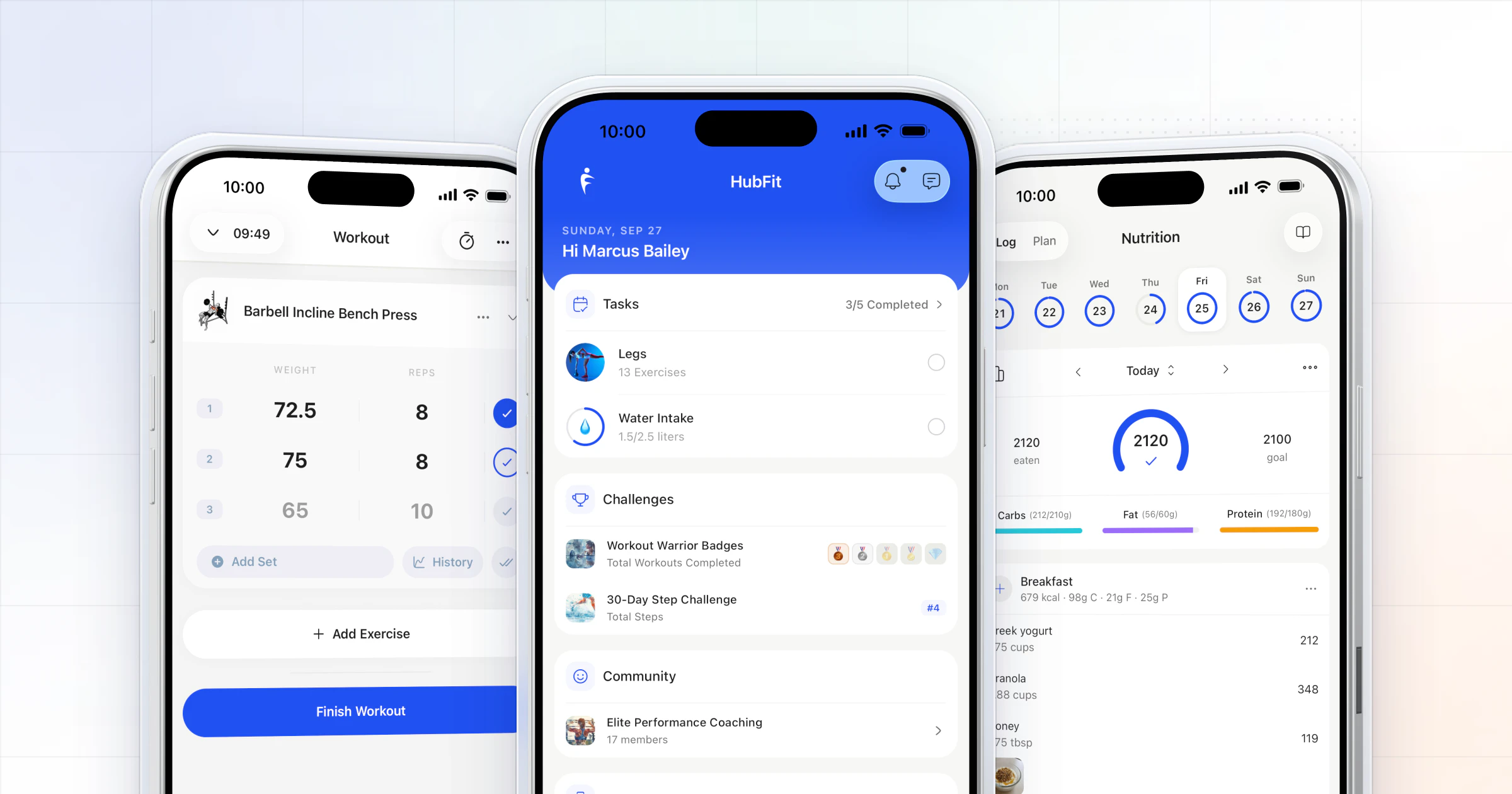
To price online coaching packages, work out your floor price, check it against market rates, then build two or three tiers priced on the result and the time each takes you. Bill monthly, put every package on one pricing page and raise prices for new clients as demand grows. HubFit lets you build those packages and sell them through Stripe.
Key takeaways
- Your floor price is the income you need plus your costs, divided by the clients you can coach well. Never price below it.
- Price the result, not the hours. Cost-plus gives you the floor; value-based pricing sets where you sit above it.
- Two or three tiers, billed monthly, separated by how much of your time each includes. Group coaching is a tier of its own.
- Raise prices for new clients first, when you are close to full or most calls say yes. Current clients keep their price until you tell them otherwise.
What is an online coaching package?
An online coaching package is a fixed offer a client buys: what they get (program, nutrition, check-ins, access to you), for how long, and at what price. A package replaces "my rate is $X an hour" with a product a client can compare and buy without a sales call.
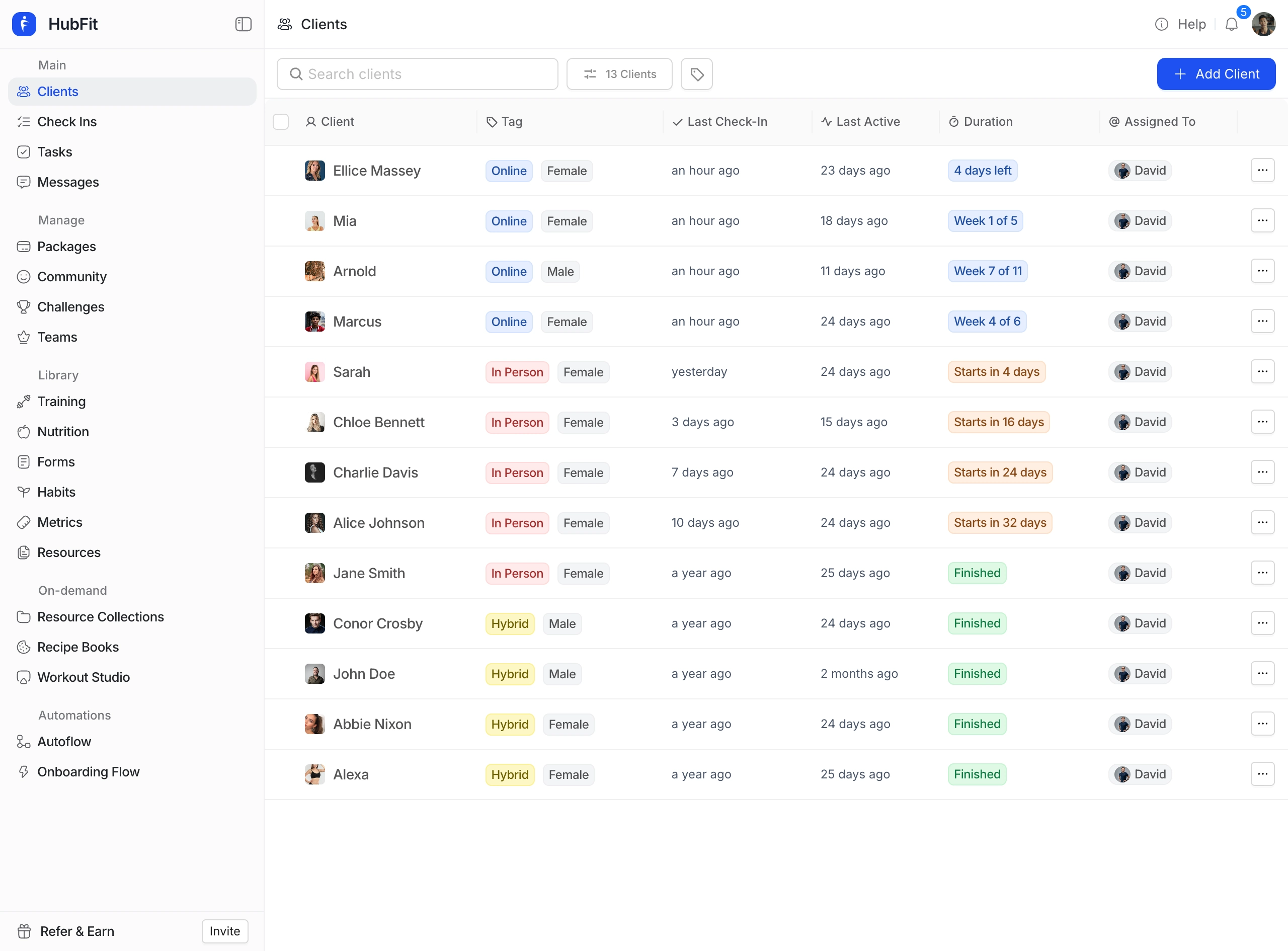
In HubFit, a package is a name, a price, a billing type and a list of benefits, plus the onboarding that runs when someone pays. Payments and packages come with Premium and up.
How much do online fitness coaches charge?
No primary source publishes what online coaches charge per month, so start from the published benchmarks for trainers and in-person sessions, then price online packages from your own floor. These are the figures worth knowing:
| Benchmark | Figure | Source |
|---|---|---|
| Trainer median pay | $22.67 an hour | BLS, May 2025 |
| Trainer median salary | $47,160 a year | BLS, May 2025 |
| One in-person session | $60 to $75 on average | ISSA |
| Session price range | $35 to $100 an hour | ISSA |
The pay figures come from the US Bureau of Labor Statistics (May 2025) and cover employed trainers and instructors. The session prices come from ISSA's guide to personal trainer costs, which puts the average single session at $60 to $75 and the wider range at $35 to $100 an hour.
What that means for an online package (our math, not a survey): a client who trains in person once a week at ISSA's average spends $240 to $300 a month for 4 hours of a trainer's time.
An online package swaps live hours for a program, nutrition, check-ins and messaging, so the client asks "what does a month of support cost me?" Price against your floor first, then check where you sit next to that monthly figure. For what trainers actually take home under each pay model, see our personal trainer salary guide.
How do you price online coaching packages?
You price online coaching packages in four steps: find your floor, choose how you price above it, build tiers, then pick how clients pay.
1. Find your floor price
Your floor price is the lowest monthly price that pays you, covers your costs and fits the number of clients you can coach well. Work it out once, then never sell below it.
Worked example (example numbers, not market data):
- Income you want each month: $6,000.
- Costs each month (software, card fees and a tax reserve; US self-employment tax alone is 15.3%): $1,500. Total needed: $7,500.
- Hours you coach each week: 20, so about 80 a month.
- Time one standard client takes: 2 hours a month. Capacity: 40 clients.
- Plan to fill 32 of those 40 spots, leaving room for busy weeks. Floor: $7,500 ÷ 32 = about $234 a month.
If that number scares you, change the inputs, not the math: coach more efficiently, add a lighter tier, or charge more.
2. Choose cost-plus or value-based pricing
Cost-plus pricing means adding your margin on top of what a client costs you to coach; value-based pricing means charging for the result a client buys, not the hours you spend. Most coaches use cost-plus to find the floor and value-based pricing to decide how far above it to go.
| Method | How it works | Use it when |
|---|---|---|
| Cost-plus | Your costs and income, plus a margin | Setting your floor price |
| Hourly | A rate for each hour you coach | Live sessions only |
| Value-based | Priced on the result and your proof | Setting the price clients see |
Hourly pricing is the one to avoid for online packages. It caps your income at the hours in your week, and it punishes you for getting faster: the better your systems, the less you earn per client.
Value-based pricing works when the package names a result, such as a first pull-up, a meet total or a first 10K, and you have testimonials that show you deliver it. The more proof you have, the further above the floor you can sit.
3. Build two or three tiers
Tiers turn "should I buy?" into "which one?" Use good, better, best, three at most, and decide what goes in each by how much of your time it includes, never by stripping out the basics every client needs.
| Tier | What's included | Example price |
|---|---|---|
| Program | App program, monthly update | $79 a month |
| Coaching | Program, nutrition, weekly check-in | $199 a month |
| VIP | Coaching plus calls, fast replies | $399 a month |
Each client takes about 30 minutes of your time a month on Program, 2 hours on Coaching and 4 hours on VIP. These prices are examples to show the range between tiers, not a survey of what coaches charge. Run your own numbers through step 1, or try our personal trainer pricing calculator. Make the middle tier the one you want most people to buy, and set the check-in rhythm for each with our guide to client check-ins.
4. Pick how clients pay
Recurring monthly billing with a minimum term suits most coaching better than one-off blocks: steady income for you, and a commitment that carries the client past the hard first weeks.
| Billing model | Best for | In HubFit |
|---|---|---|
| Monthly, until canceled | Ongoing coaching | Monthly, until canceled |
| Fixed term | A 12-week program or minimum term | Monthly, 1 to 12 months |
| Pay in full | Cash up front | One-time package |
| Free | A waitlist or taster | Free package |
How do you price group coaching?
Price group coaching per head from your floor: the group's monthly price times the number of members should beat what the same hours earn you in 1-on-1, while each member pays less than your 1-on-1 tier. ISSA makes the same point from the client's side: group training rates mean a lower price per person.
Worked example (example numbers, not market data):
- Your Coaching tier is $199 a month and takes 2 hours a client, so you earn about $100 for each hour of your time.
- A group program at $79 a month with 12 members brings in $948 a month.
- It takes about 6 hours a month: a weekly group call, one shared check-in review and replies in the group.
- That is about $158 an hour of your time, and each member pays well under half your 1-on-1 price.
Keep groups small enough that everyone still gets an answer: our rule is 8 to 15 members a group. What the group gets that 1-on-1 doesn't is each other: shared wins, a little competition and someone else asking the question they were shy to ask.
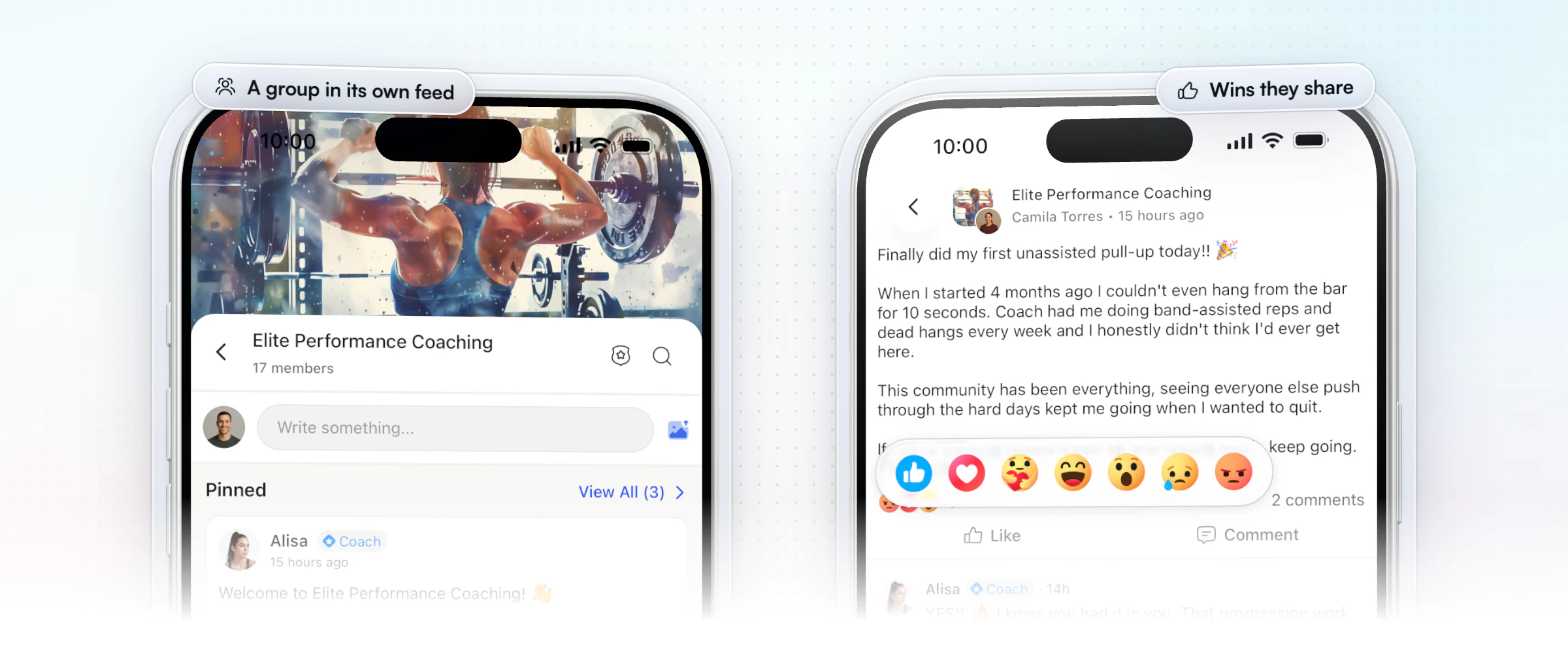
In HubFit, a group runs in its own community feed or group chat, so members connect with each other inside the app instead of a separate WhatsApp or Facebook group. You can have as many communities as you want, one per cohort if you like. Group chats and communities are part of Ultimate.
What are some coaching package examples by niche?
Good coaching packages name the result in the title and include only what that client needs. Here are four examples to adapt, one per niche:
| Niche | Package | What's included |
|---|---|---|
| Fat loss | 12-Week Reset | Program, nutrition plan, weekly check-in |
| Strength | Meet Prep Block | Custom program, video form reviews |
| Nutrition only | Macro Coaching | Meal plan, weekly nutrition check-in |
| Hybrid | Gym + App Coaching | In-person sessions, app program |
As a starting point (example prices, not market data): the nutrition-only package near your Program tier, fat loss and strength near your Coaching tier, and the hybrid package priced as your session rate times sessions plus your Program tier. Then adjust to your floor.
How does HubFit help you sell packages at the price you set?
HubFit, the #1 coaching app, turns the pricing on this page into packages a client can buy in under a minute, and it protects the price after the sale. Clients use the app free, and it's rated 4.9 on the App Store and Google Play. Here is what it does for each decision above:
- Every billing model, built in. Each package is one-time, weekly, monthly or free, for 1 to 12 weeks or months or until canceled, with a free trial (weekly and monthly packages) or an initial fee, never both.
- A checkout that doesn't need you. Clients pick a package on your branded pricing page, leave their name and email, and pay through Stripe with Apple Pay or Google Pay, in 9 currencies. Each package also has its own page, and a hidden package still works by direct link, which suits a high-ticket tier you only offer after a call.
- Price rises that leave current clients alone. Change a package's price and only new purchases use it: existing subscriptions keep the price they signed up at.
- Each tier delivered the moment they pay. Attach an onboarding flow to a package and the buyer gets that tier's program, nutrition plan, habits and check-ins, with the app showing only the features that tier includes. See how to onboard online coaching clients.
What does your software really cost per client?
Your software costs you its monthly bill divided by your active clients, so check it as a share of one client's package price. With your own numbers (example only): $150 a month of software and tools across 30 clients is $5 a client, 2.5% of a $199 package. The card fee sits on top: in HubFit you pay Stripe's standard rate only, with no HubFit transaction fee, and the app is always free for your clients. For the whole payments side, see a coaching app with client payments.
Should you offer a free trial or a setup fee?
Use a free trial (3, 7, 14 or 30 days) on low-ticket, self-serve tiers billed weekly or monthly, and a setup fee on high-touch tiers where onboarding takes real work. In HubFit, a package has one or the other, not both, and a setup fee is charged once with the first payment.
Coupons and discounts (a percentage or a fixed amount) are best kept for a reason with an end date: a launch, a referral, a returning client. Our guide to coaching discounts covers which campaigns to run and what each one costs you.
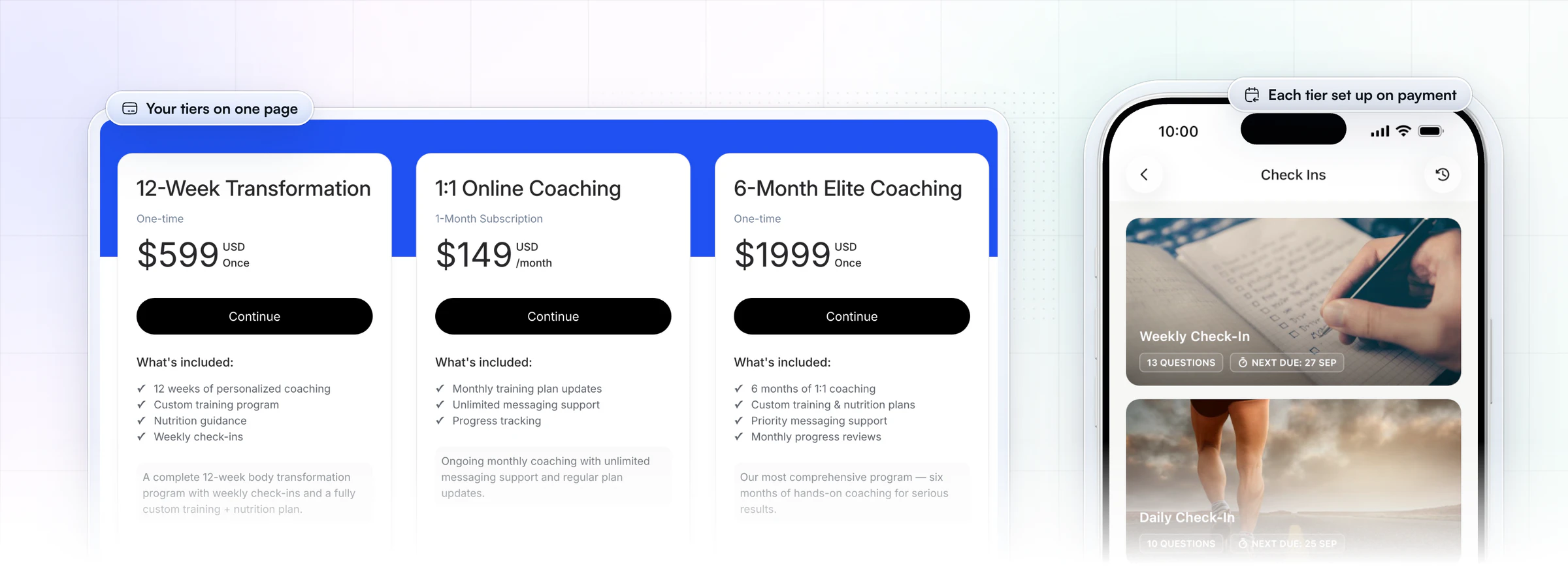
What should your coaching pricing page show?
Your pricing page should let a stranger pick a package and pay in under a minute, without messaging you first.
- A package name that says the result, such as "12-Week Strength Reset".
- The price and how it bills: per month, for how long.
- Three to six benefits in the client's words.
- The trial or setup fee, stated plainly.
- One button per package that leads to checkout.
- Your logo and brand color, so it feels like your business.
In HubFit, your packages become a branded pricing page automatically, like the one shown above, with a single link to share in DMs and bios.
When should you raise your prices?
Raise your prices when demand outgrows your capacity. Four signals tell you it's time, each with the line we'd use (our rules of thumb, not a standard):
- You're close to full. About four in five spots taken, such as 32 of 40 in the worked example.
- Almost every call says yes. If 9 of 10 sales calls buy, your price is below what people will pay.
- You have new proof. A run of client results or testimonials raises what your package is worth.
- A waitlist forms. People waiting to pay you is the clearest signal there is.
A better client experience is new proof too. Jesse Astill of ASTL Performance raised his prices after moving his coaching from spreadsheets into a clean, premium app.
“I've been able to put my prices up so I'm able to make more money. I'm able to give my clients a better experience.”

Put new clients on the new price first. For current clients, either leave them where they are or give them notice and a date. A two-line message is enough:
Hi [first name], from [date], my coaching price for new clients goes up to [new price]. Your price stays at [current price] until [date], and I'll remind you before anything changes.
How do you support high- and low-ticket clients?
You support both by changing how much of your time each tier gets, not the quality of the program. Low-ticket clients get a strong fixed program and the app; high-ticket clients get your personal attention.
- Program: a fixed plan for a common goal on low ticket; built and adjusted for them on high ticket.
- Check-ins: monthly or self-guided on low ticket; weekly, with a personal reply on high ticket.
- Messaging: off, or a set reply window on low ticket; direct and fast on high ticket.
- Calls: none on low ticket; scheduled calls on high ticket.
What are the most common coaching pricing mistakes?
The most common mistake is pricing by the hour. The rest follow from it:
- Pricing by the hour. It caps your income and punishes you for getting faster.
- Too many tiers. Five options stall the decision. Stay at three.
- Giving onboarding away. A high-touch tier with no setup fee pays nothing for your heaviest week.
- Chasing invoices by hand. Manual renewals cost you time and clients. Let subscriptions renew themselves.
FAQ
Here are short answers to what coaches ask most about pricing coaching packages.
How much should an online fitness coach charge?
Charge at least your floor price: the income you need plus your costs, divided by the clients you can coach well. Above that, price by the result and your proof. As a benchmark, ISSA puts an average in-person session at $60 to $75, so weekly sessions run $240 to $300 a month. Our pricing calculator helps you test your numbers.
What is value-based pricing in coaching?
Value-based pricing means charging for the result a client buys, not the hours you spend. You name the outcome in the package, such as a first pull-up or a 12-week strength block, and price it on what that result is worth to them and the proof you have that you deliver it.
Is it better to charge low or premium prices?
Low prices fill spots fast but need many clients and leave little time per person; premium prices need proof and a clear result but give each client more of you. Most coaches do best with a low-ticket program tier and one premium coaching tier, with the floor price as the line neither crosses.
How much do personal trainers charge?
ISSA puts the average single in-person session at $60 to $75, with a range of $35 to $100 an hour. Employed trainers earn a median of $22.67 an hour, per the BLS (May 2025). See our personal trainer salary guide for what each pay model takes home.
How much should I charge for group coaching?
Price each member below your 1-on-1 tier, then check the group's total against your hourly floor. In the example above, 12 members at $79 a month earn about $158 for each hour of your time, against about $100 in 1-on-1. Keep groups to 8 to 15 members so everyone gets an answer.
Should I charge monthly or per program?
Charge monthly for ongoing coaching, with a minimum term such as three months, so income is steady and clients stay past the hard weeks. Sell a fixed program (one payment or a set number of months) when the offer has a clear end. Our guide to selling workout programs online covers one-time programs.
Should I put my prices on my website?
Yes, for program and coaching tiers: a public price filters out poor fits and lets people buy without a call. For a high-ticket tier, you can show a starting price and book a call first. See how payments and packages work.
How much does HubFit cost?
HubFit's plans and prices are on HubFit's pricing page, and every plan starts with a 14-day free trial. HubFit adds no transaction fee on top of Stripe's standard rate, and clients always use the app free.
Price it, then sell it in one place
A good price only pays when clients can buy it easily and stay. Set your floor, pick your tiers, then build the packages in HubFit and send one link: each buyer is set up before you open their profile.