

You already know that challenges work. If you've read The Ultimate Guide to Client Challenges for Online Coaches, you know why they drive retention, how to design them, and what makes the difference between a challenge that runs for 30 days and one that dies after 5.
But here's the question that comes next: which platform should you actually use to run them?
Not every coaching platform treats challenges the same way. Some have invested heavily in the feature, building out multiple challenge types, badge systems, auto-tracking integrations, and notification engines. Others have bolted on a basic version to check a box. And a few don't offer challenges at all, leaving you to cobble together something with spreadsheets and group chats.
This comparison breaks down seven of the most popular online coaching platforms and evaluates their challenge features side by side. Whether you're an online coach, personal trainer, or running a coaching team, the goal isn't to declare a winner and move on. It's to help you understand what each platform actually offers so you can pick the one that fits your coaching style, your client base, and the kind of challenges you want to run.
If you're also considering standalone tools like challenge-specific apps or even spreadsheets, we cover those in 5 Best Tools to Run Fitness Challenges With Your Coaching Clients.
Why the Challenge Feature Matters More Than You Think
Challenges aren't a side feature. For coaches who use them well, they're a core part of the client experience. They turn passive clients into active ones. They keep someone training on the day they were about to skip. They transform a roster of individuals into a community with shared goals and visible progress.
The platform you choose determines what kind of challenges you can run, how much manual work you'll have to do, and ultimately how much engagement you'll get out of the feature. A platform with auto-tracking, tiered badges, and real-time leaderboards will generate dramatically more engagement than one where you're manually updating a scoreboard every evening.
This isn't a minor decision. If challenges are going to be part of your coaching toolkit - and they should be - you need a platform that treats them as a first-class feature, not an afterthought.
What to Look for in a Challenge Feature
Before diving into specific platforms, it's worth establishing what separates a truly useful challenge system from a basic one. These are the criteria we'll evaluate each platform against.
Challenge Types and Variety
The more challenge types a platform supports, the more flexibility you have to design challenges that align with your coaching goals. Workout challenges (total sessions, volume, reps) serve a different purpose than nutrition challenges (days logged, protein targets, calorie targets), and health challenges like steps serve yet another. A platform limited to one or two types limits what you can do. Ideally, you want coverage across all three categories so you can rotate challenge themes throughout the year without repeating yourself.
Challenge Modes
There are two fundamental ways a challenge can work: competitive (leaderboard) and progressive (milestone). Leaderboard mode ranks participants against each other. Milestone mode lets participants earn badges by hitting personal thresholds. The best platforms offer both, because competitive challenges fire up your advanced clients while milestone challenges keep beginners from feeling left behind. A platform that only offers one mode forces you to choose between engagement styles rather than matching the mode to the group.
Auto-Tracking
This is the single most important technical feature. If clients have to manually report progress, participation drops within days. If coaches have to update leaderboards by hand, the challenge becomes another administrative burden. Auto-tracking pulls data directly from completed workouts, logged nutrition, or synced health data with no manual input from anyone. The difference between auto-tracked and manually tracked challenges is often the difference between a challenge that runs its full duration and one that dies in week one.
Gamification and Badges
Badges transform a number on a screen into something that feels earned. A tiered badge system where clients progress through multiple levels creates ongoing motivation that a simple pass/fail threshold can't match. The quality and variety of badge designs also matters. Clients who are proud of what they've earned are more likely to screenshot it, share it, and keep pushing for the next tier.
Notifications
A challenge that doesn't communicate with participants is just a dashboard nobody checks. The notification system should cover the full lifecycle (start, deadline approaching, ended), celebrate achievements (badges earned, all tiers completed), and fuel competition (entering the top 3, taking the lead). Without notifications, you lose the real-time drama that makes challenges compelling.
Branding and Multi-Coach Support
Cover images, custom names, and themed badges make a challenge feel like an event rather than a menu item. These details directly affect participation rates because clients take branded, polished challenges more seriously than generic ones.
And if you run a coaching team, multi-coach support with independent notification preferences keeps everyone informed without creating confusion. A challenge feature that only works for solo coaches becomes a bottleneck the moment your business grows.
Platform-by-Platform Breakdown
HubFit
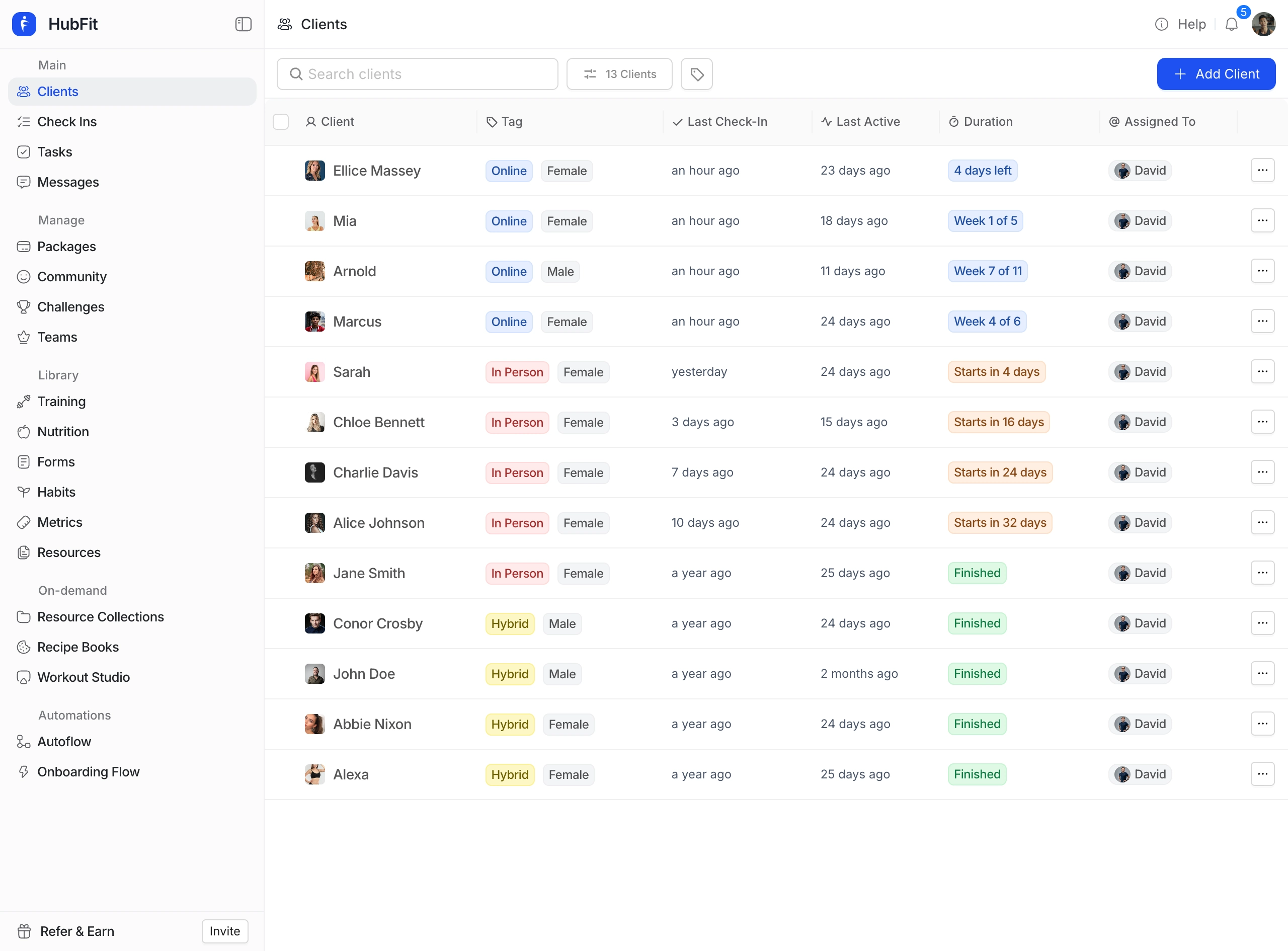
HubFit's challenge feature is the most comprehensive of the platforms reviewed here. It offers 7 challenge types across three categories: 3 workout challenges (total workouts, total volume, total reps), 3 nutrition challenges (days logged, protein target days, calorie target days), and 1 health challenge (total steps).
Coaches choose between two modes: leaderboard for competitive ranked challenges and milestone for progressive badge-based challenges. This lets you run a fierce step competition for your advanced group and a gentle nutrition consistency challenge for beginners, all within the same platform.
Where HubFit truly separates itself is the badge system. Milestone challenges use a 5-tier structure, and coaches choose from 8 unique themes - Medals, Iron, Journey, Summit, Warriors, Animals, Elements, and Ranks. Each theme tells a progression story (Iron goes from Lifter to Olympian, Warriors from Warrior to Legend). Tiered badges create a psychological escalation that keeps clients pushing toward the next level long after initial novelty fades. No other platform reviewed here offers anything comparable.
Auto-tracking covers all challenge types. Workout data pulls from completed sessions. Nutrition data pulls from logged meals. Step data syncs from Apple Health on iOS and Health Connect on Android, meaning step challenges require zero effort from the client.
The notification engine covers three categories: lifecycle (challenge starts, ending soon, ended), achievement (badge earned, all tiers completed), and competition (entered top 3, new leader). Cover images come with 24 defaults plus custom upload. Multi-coach support is fully native, with each coach controlling their own notification preferences independently.
Trainerize
Trainerize has invested meaningfully in its challenge feature. Coaches can create challenges based on 6 trackable activities, and the platform supports both leaderboard competition and threshold-based challenges where clients aim to hit a target number.
The threshold system works differently from tiered milestones. In Trainerize, the threshold is a single target - clients either hit it or they don't. You set a target of 20 workouts, and clients who reach 20 pass. This creates a binary outcome rather than the progressive escalation that multiple tiers provide.
Trainerize includes progress badges and streak tracking, and the auto-tracking is solid. Challenges are included in all paid plans, so there's no upgrade required. The limitation is in depth - you won't find the same variety of types, multi-tier badge progression, or notification granularity that more challenge-focused implementations offer. But for coaches wanting a reliable challenge feature within a mature platform, Trainerize delivers a competent experience.
Everfit
Everfit takes a wide-net approach, offering 9 or more leaderboard types across 4 categories. The metric variety is a genuine strength. The platform also features an AI-powered push-up challenge using the phone's camera for automatic rep counting - clever, though limited to that one exercise.
Everfit integrates challenges with community forums and its Autoflow automation system, which can trigger challenges based on client lifecycle events. That's valuable for coaches who want to systematize their challenge rollout.
The gap is in gamification. There's no tiered badge system, and challenges are primarily leaderboard-based. Coaches who prefer progressive milestone-style challenges with escalating rewards have fewer options. The platform is strong on breadth of trackable metrics but thinner on the psychological engagement tools - badges, tiers, themed progressions - that turn a good challenge into a great retention driver.
My PT Hub
My PT Hub positions itself as affordable and full-featured. Coaches can create challenges, and the platform includes personal best tracking and gamified workout elements. The real draw is unlimited clients on its plans, appealing for coaches who don't want per-client pricing.
The challenge feature itself is basic. No tiered badge systems, limited leaderboard customization, and partial auto-tracking. For coaches wanting a simple challenge option within an affordable platform, it's reasonable. For coaches who see challenges as a primary engagement driver, it may feel limiting.
TrueCoach
TrueCoach is well-regarded for one-on-one coaching - workout delivery, client communication, and the personal coaching relationship. However, it does not offer a built-in challenge feature. No leaderboards, no badges, no streaks, no challenge modes.
This isn't a criticism of TrueCoach's philosophy. Some coaches deliberately avoid gamification because they believe the direct relationship should be the primary motivator. But if challenges matter to your coaching model, you'll need to run them outside the platform with spreadsheets or standalone apps, introducing friction that an integrated solution avoids.
PT Distinction
PT Distinction offers basic challenge support, but without leaderboards or badges. The functionality is closer to goal-tracking than gamified challenges. Where the platform invests instead is community building - client groups and community interaction that serve some of the same engagement purposes through a different mechanism.
Coaches looking for competitive leaderboards, progressive milestones, and auto-tracked metrics won't find them here.
TrainHeroic
TrainHeroic is designed for athletic performance coaches, sports teams, and gym-based group training. It supports team-based challenges, which fit that audience well.
But the feature isn't built for individual online coaching. You won't find client-roster leaderboards or individual milestone progressions with tiered badges. If your business is online coaching with individual clients or small groups, TrainHeroic's challenge feature won't serve your needs.
Feature Comparison Table
| Feature | HubFit | Trainerize | Everfit | My PT Hub | TrueCoach | PT Distinction | TrainHeroic |
|---|---|---|---|---|---|---|---|
| Leaderboard Challenges | ✅ | ✅ | ✅ | ✅ | ❌ | ❌ | ❌ |
| Milestone/Badge System | ✅ | ❌ | ❌ | ❌ | ❌ | ❌ | ❌ |
| Auto-Tracking | ✅ | ✅ | ✅ | ❌ | ❌ | ❌ | ❌ |
| Health Data Sync (Steps) | ✅ | ❌ | ✅ | ❌ | ❌ | ❌ | ❌ |
| Badge Themes | ✅ | ❌ | ❌ | ❌ | ❌ | ❌ | ❌ |
| Notifications | ✅ | ✅ | ✅ | ✅ | ❌ | ❌ | ❌ |
| Custom Cover Images | ✅ | ❌ | ❌ | ❌ | ❌ | ❌ | ❌ |
| Multi-Coach Support | ✅ | ❌ | ✅ | ❌ | ❌ | ❌ | ✅ |
The Verdict
The right platform depends on what role challenges play in your business.
If you don't need gamification and your coaching model relies on the one-on-one relationship, TrueCoach does that well - but you'll need to run challenges outside the platform entirely. If you want a basic challenge option, Trainerize and My PT Hub both cover the fundamentals. Everfit gives you the widest range of leaderboard metrics if variety is your priority.
But if you look at the comparison table, the pattern is hard to miss. HubFit is the only platform that checks every box. It's the only one with a tiered badge system. The only one with both leaderboard and milestone modes. The only one with auto-tracking across workouts, nutrition, and health data. And the only one where cover images, badge themes, and multi-coach notification controls are all built in rather than missing or partial.
That matters because challenges aren't just a feature you turn on once. They're something you run continuously - different types for different client groups, month after month. A platform that only covers part of the picture means you're either working around its gaps or skipping features your clients would benefit from.
The comparison table tells the story. Every coach should weigh the features that matter most to their business, but for challenges specifically, the depth isn't close.
Where to Go From Here
If you haven't already, start with The Ultimate Guide to Client Challenges for Online Coaches for the full framework on challenge design, from picking the right type and mode to setting badge thresholds and troubleshooting common failures.
If you're still weighing options between coaching platforms, standalone apps, and DIY tools, 5 Best Tools to Run Fitness Challenges With Your Coaching Clients covers the broader landscape.