

Check-ins are the heartbeat of online coaching. Weekly or biweekly, you review progress, adjust the plan, and give your client the direction they need for the next stretch.
But what happens in between?
For most coaches, the answer is: not much. The client gets their check-in on Monday, feels motivated until Wednesday, and by Friday they're skipping workouts, eyeballing portions, and hoping you won't notice at the next check-in. By the time you do notice, a week of poor adherence has already happened.
The accountability gap between check-ins is where most coaching relationships quietly erode. Whether you're an online coach or personal trainer, the problem isn't bad programming or poor communication during check-ins. It's the silence between them. The clients who churn after 3-4 months almost always follow the same pattern: strong start, gradual drift, missed check-ins, gone.
The fix isn't more check-ins. It's building systems that keep clients accountable without requiring your constant manual attention. For a deeper look at one of the most powerful accountability systems - client challenges - see our Ultimate Guide to Client Challenges for Online Coaches. And if you want to understand the broader psychology behind why these strategies work, How to Use Gamification to Improve Client Retention as an Online Coach covers the research.
Here are five strategies that work.
The 5 strategies
- 1. Automated Habit and Nutrition Tracking
- 2. Client Challenges With Leaderboards and Badges
- 3. In-App Messaging and Community Features
- 4. Progress Photo and Metric Check-Ins
- 5. Push Notifications and Automated Reminders
Way 1: Automated Habit and Nutrition Tracking
The simplest form of accountability is visibility. When clients know their coach can see whether they logged their meals or completed their workouts, their behavior changes - even if you never say a word about it.
This is the Hawthorne Effect in action. People perform better when they know they're being observed. A nutrition tracker that's visible to the coach creates a gentle, always-on form of accountability that doesn't require a single message from you.
The key word is "automated." If you're asking clients to send you food photos via text or fill out a Google Form every day, you're creating friction for them and administrative work for yourself. The better approach is a system where the client logs their nutrition in an app and that data flows to your dashboard automatically. You can glance at it when you want, but you don't have to. The accountability comes from the client knowing the data is there.
Same principle applies to habit tracking. Whether it's water intake, sleep, supplement compliance, or daily movement, giving clients a simple way to track daily habits - and knowing you can see the results - keeps them honest between touchpoints.
Way 2: Client Challenges With Leaderboards and Badges
If habit tracking is passive accountability, challenges are active accountability. A challenge gives the client something specific to aim for beyond their regular program, with visible consequences (leaderboard ranking or badge progress) that create urgency.
A well-designed challenge turns the days between check-ins from "maintenance mode" into "game mode." The client isn't just following their program because you told them to. They're chasing a badge tier, protecting their leaderboard position, or trying to hit a daily target that feeds into a larger goal.
Challenges work for accountability because they add social proof and visible progress to the equation. A client who sees their peers logging workouts and climbing the leaderboard on a Tuesday afternoon is more likely to get their own session in than a client who's just staring at a program they'll review at next week's check-in.
The most effective challenge types for accountability are consistency-based: Total Workouts Completed, Total Days Logged, and Protein Target Days. These reward showing up daily, which is exactly the behavior that erodes between check-ins.
For concrete challenge ideas you can launch today, check out 7 Client Challenge Ideas That Boost Retention and Engagement. And for the psychology behind why challenges work, the Ultimate Guide to Client Challenges covers it in depth.
Way 3: In-App Messaging and Community Features
Sometimes accountability is as simple as a human connection. A quick message from the coach - "Hey, saw you crushed your upper body session yesterday, nice work on the bench PR" - costs you 15 seconds and can carry a client through the rest of the week.
The challenge is doing this at scale. If you have 30 clients, sending personalized messages to each one every few days is a significant time commitment. This is where in-app messaging features and community spaces help.
A community feature within your coaching platform lets clients interact with each other, share wins, post updates, and create social accountability without you being the sole source of engagement. When clients see their peers posting workout selfies and celebrating milestones, the social pressure to participate does the accountability work for you.
The coaching lesson here is that accountability doesn't always have to come from the coach. Sometimes the most powerful accountability is peer accountability - and your job is to create the environment where that happens naturally.
Smart coaches combine personal 1-on-1 messages (targeted, low-volume, high-impact) with community engagement (broad, self-sustaining, ambient accountability). The personal messages show clients you're paying attention. The community shows them they're part of something bigger.
Way 4: Progress Photo and Metric Check-Ins
Weekly or biweekly check-ins catch big trends. But what about the smaller data points that accumulate between those check-ins?
Progress photos, body measurements, and performance metrics collected between formal check-ins create micro-accountability moments. A client who takes a progress photo on Wednesday morning is reminded, in that moment, of their goals. The act of stepping in front of the camera and seeing themselves is a small accountability trigger that costs nothing.
The same applies to regular weigh-ins or body measurements. A client who weighs themselves three times a week and sees that data flowing to their coach's dashboard is less likely to go off-plan than a client who only confronts the scale once every two weeks at check-in time.
The important nuance is that these data points should feel supportive, not surveillance-like. Frame them as progress tools, not compliance checks. "I want to see your weekly progress photos so we can spot trends together" is very different from "Send me photos so I can tell if you're following the plan."
Give clients the tools to submit this data easily - ideally within the same app where they do everything else - and make it clear that the data is for their benefit as much as yours.
The key is frequency without burden. A client who takes a 30-second progress photo on Wednesday and a quick weigh-in on Friday has two micro-accountability moments that week, neither of which required your time or attention. The data is there if you want to review it. The accountability happened regardless.
Way 5: Push Notifications and Automated Reminders
This is the most underrated accountability tool in online coaching. A well-timed push notification can be the difference between a client who trains today and a client who "plans to train tomorrow."
The best coaching platforms send notifications automatically based on real events: a workout was assigned, a check-in is due, a challenge is ending soon, a badge was just earned, someone took the lead on the leaderboard. These notifications don't require you to remember to send anything. They fire based on what's actually happening in the client's coaching journey.
The psychology is straightforward. A notification that says "Your 30-Day Consistency Challenge ends in 24 hours" creates urgency. A notification that says "You just earned the Pathfinder badge" creates positive reinforcement. A notification that says "New workout assigned for today" creates clarity on what to do next.
The combination of these notification types creates an ambient coaching presence. The client feels guided, nudged, and celebrated between check-ins without you having to manually orchestrate any of it.
The key is balance. Too many notifications and clients mute them. Too few and the silence between check-ins returns. The sweet spot is notifications that feel earned and timely - celebrating something the client just did, or reminding them of something they care about. The best systems let the coaching platform determine the right moments to reach out based on the client's activity - or inactivity.
Combining Multiple Strategies for Maximum Accountability
No single strategy solves the accountability gap on its own. The coaches with the best retention rates combine multiple approaches to create layers of accountability that reinforce each other.
Here's what a well-designed accountability stack looks like:
Layer 1: Passive tracking. Nutrition logging and habit tracking that the client does daily, creating visibility for both the client and the coach.
Layer 2: Active engagement. A running challenge (leaderboard or milestone) that gives the client something to compete for or progress toward every single day.
Layer 3: Social accountability. A community space where clients interact, share wins, and hold each other accountable without the coach being the sole driver.
Layer 4: Personal touchpoints. Targeted 1-on-1 messages from the coach at key moments - after a great session, after a missed day, after a badge earned.
Layer 5: Automated nudges. Push notifications that celebrate achievements, remind about deadlines, and keep the coaching experience present in the client's day.
Each layer catches what the others miss. A client who ignores the push notification might be motivated by the leaderboard. A client who doesn't check the community might respond to a personal message. A client who's lost motivation from the program might re-engage through a challenge badge they're one workout away from earning.
The more layers you have, the smaller the gaps where accountability can leak. And the best part is that most of these layers are automated once you set them up. The upfront work is minimal. The ongoing impact is significant.
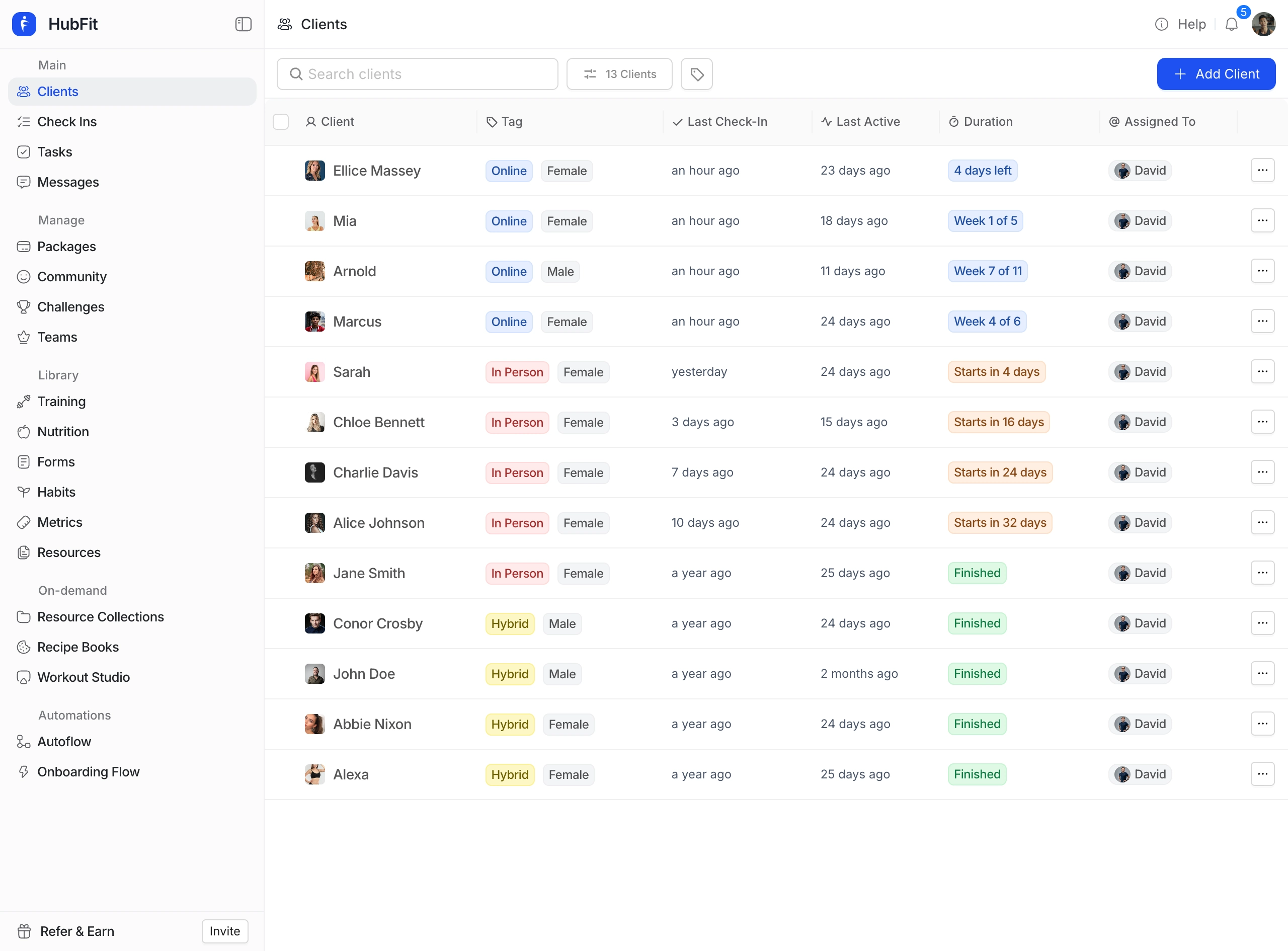
HubFit was designed with this layered accountability model in mind. It combines habit and nutrition tracking, auto-tracked challenges with leaderboards and tiered badges, community features, in-app messaging, and intelligent push notifications into a single coaching platform. Instead of stitching together five separate tools to cover each layer, you get all of them working together out of the box. Set up a challenge in under 5 minutes, let the automated notifications handle the daily touchpoints, and focus your energy on the personal coaching moments that actually require you.